Building software is harder than buying it, and hiring the people to build it is harder still. In 2024, more than half of the EU companies with ICT vacancies had trouble filling them, and only 30% of companies deliver their large technology programmes on time, on budget and in full scope. That is why many European companies now build their custom software with a nearshore team: a partner in a nearby country that works in the same working day, under the same EU rules.
Spain is one of the strongest options. It shares Central European Time with most of the continent, applies EU law on data protection, accessibility and cybersecurity, and its average hourly labour cost was €26.4 in 2025, against €34.9 across the EU. This guide explains when custom software pays off, what a project costs in 2026, how a nearshore project works day to day, how to make sure you own the code under Spanish law, and how to choose a partner.
It is written by Macaque, a Spanish technology consultancy certified to ISO/IEC 27001:2023 that provides custom software development. If you are looking for engagement models and rates by role rather than a project, read our guide to nearshore software development in Spain. Where we give our own prices or opinions, we say so; everything else is sourced.
Nearshore custom software development in 60 seconds
What it is: software designed and built for your processes, data and rules by a partner in a nearby country, working in your time zone.
When it pays off: when the process sets you apart, when you need to connect several systems, or when off-the-shelf software forces you to work the way you don't want to.
When it doesn't: for processes that are the same in every company, such as accounting, payroll or email.
Cost: based on our 2026 rates, from €7,200 for a focused integration, €64,800–115,200 for an MVP and from €172,800 for a full platform, excluding VAT.
Timeline: one to two months for an integration, three to four for an MVP and six to nine for a platform.
How it works: discovery, design, iterative development, testing and launch, and continuous evolution, with demos every two weeks.
What you must not skip: a contract that assigns you the rights to the code, acceptance criteria and a maintenance plan.
What is custom software development?
Custom software, also called bespoke software, is an application designed and built to meet the specific needs of one company: its processes, business rules, data and users. Off-the-shelf software, by contrast, is a product made for many companies at once, adapted through configuration and usually paid for with a licence or a per-user subscription.
Custom does not mean starting from scratch. Custom software is built on existing languages, frameworks, libraries, cloud services and APIs. What is designed for you is what makes you different: the business logic, the workflows, the integrations and the user experience.
Custom, off-the-shelf and customised software
Factor
Off-the-shelf (SaaS or package)
Customised off-the-shelf
Custom software
Fit with your processes
You adapt to the software
Partial, within what the product allows
Complete
Time to go live
Days or weeks
Weeks or months
Months
Upfront cost
Low
Medium
High
Running cost
Licence or subscription per user
Licence plus maintenance of the customisation
Maintenance and infrastructure
Ownership
The vendor's
The vendor's, except your own developments
Yours, if the contract says so
Roadmap
Set by the vendor
Limited by product updates
Set by your priorities
Competitive advantage
None: your competitors use the same
Low
High, if the process sets you apart
Examples of custom software
Operations platforms: order, route, warehouse or production management with your own rules.
Customer and supplier portals: B2B ordering, case tracking, documents and self-service.
Mobile apps for field teams: job sheets, inspections or stocktakes that work offline.
Custom ERP or CRM: for processes that a standard ERP cannot handle without forcing them.
Integrations and middleware: APIs that connect your ERP, online shop, CRM and warehouse.
Calculation engines: pricing, quoting or planning with complex rules, common in insurance, energy and logistics.
AI-powered tools: internal copilots, document classification or assistants that know your procedures.
SaaS platforms: software a company builds to sell to its own customers.
When custom software pays off (and when it doesn't)
Signs you need it
Your key process sets you apart and no product covers it without forcing it.
Critical parts of the business run on spreadsheets and email.
You use several tools that don't talk to each other, and someone copies data between them by hand.
Per-user licences grow faster than the value they deliver.
You have security, regulatory or data location requirements that off-the-shelf software doesn't meet.
You want to launch a digital product or a new service for your customers.
When it doesn't pay off
The process is the same in every company: accounting, payroll, email or office tools.
A SaaS product covers almost everything you need and configuration covers the rest.
You need a solution within weeks and the need is temporary.
Nobody in your company can spend time defining, prioritising and validating.
Custom software, SaaS or low-code: how to decide
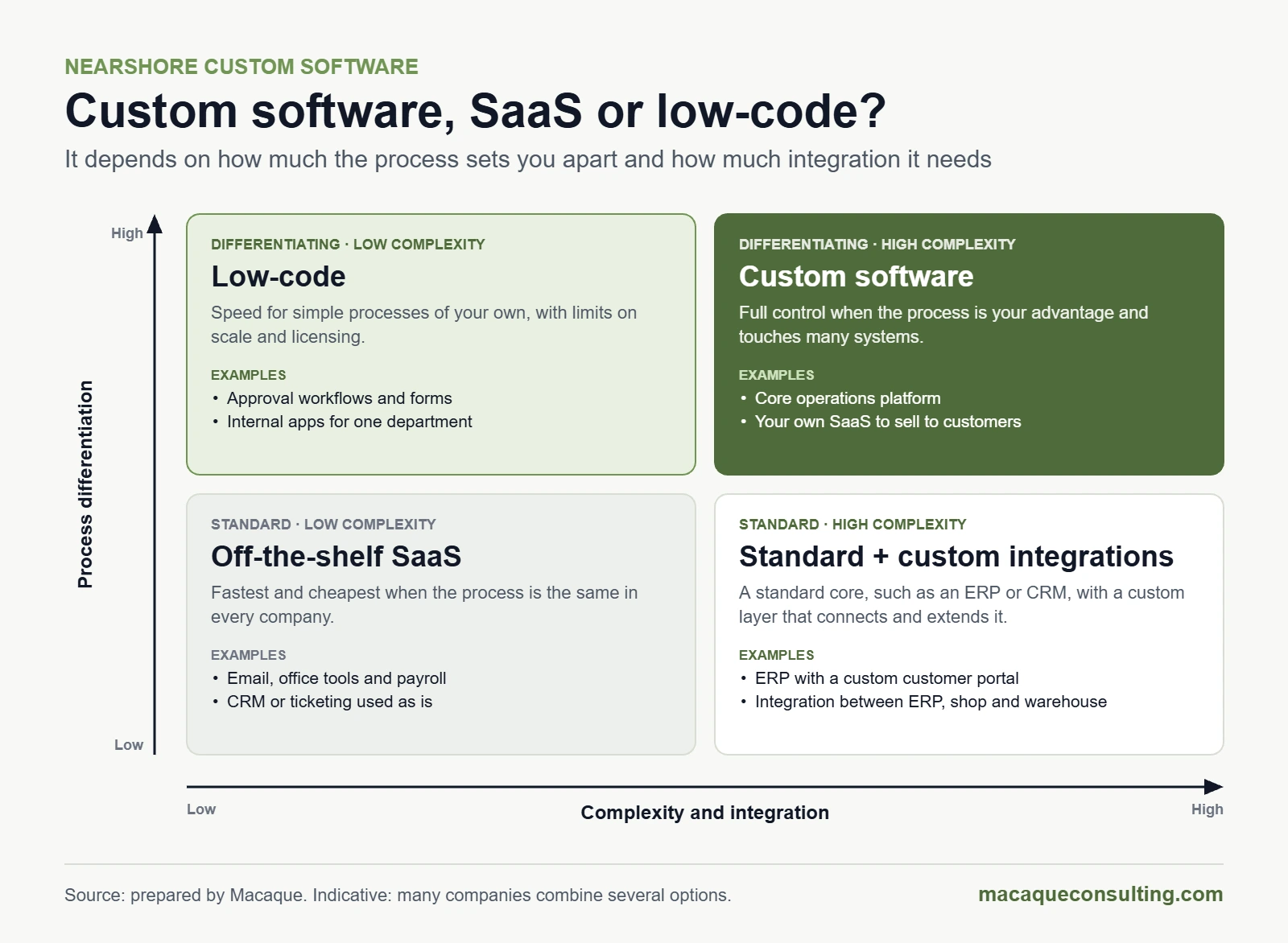
Two questions frame the decision: how much the process sets you apart, and how much complexity and integration it requires. Together they give four options, which many companies combine: a standard ERP at the core, custom integrations, low-code apps for simple workflows and custom software only where the advantage lies. If your case involves a market ERP or CRM, our enterprise platforms service may be a better fit.
Prepared by Macaque.
Why build custom software with a nearshore team in Spain
The same working day. Mainland Spain uses Central European Time, like Germany, France, the Netherlands, Belgium, Italy and the Nordic countries; the UK, Ireland and Portugal are one hour behind. Product owners and developers can solve questions the same morning instead of waiting a day.
The same rules. The GDPR, the AI Act and the Cyber Resilience Act apply directly in Spain, and the European Accessibility Act is transposed into Spanish law. For an EU company, a Spanish partner does not involve an international data transfer.
Lower labour costs. The average hourly labour cost in Spain was €26.4 in 2025, compared with €34.9 in the EU and €45.0 in Germany. We compare more countries in our nearshore software development guide.
Product teams, not just coders. A custom software project needs product, design, development and QA working together. A nearshore partner can provide the whole team, which is hard to hire in many European markets.
English: check it in interviews. Spain ranks 36th of 123 countries in the EF English Proficiency Index 2025, in the moderate band. Make sure the team lead and product owner are fluent, and keep documentation in English.
Easy travel. Spain is a short flight from most European capitals, so an in-person kick-off and regular workshops are realistic.
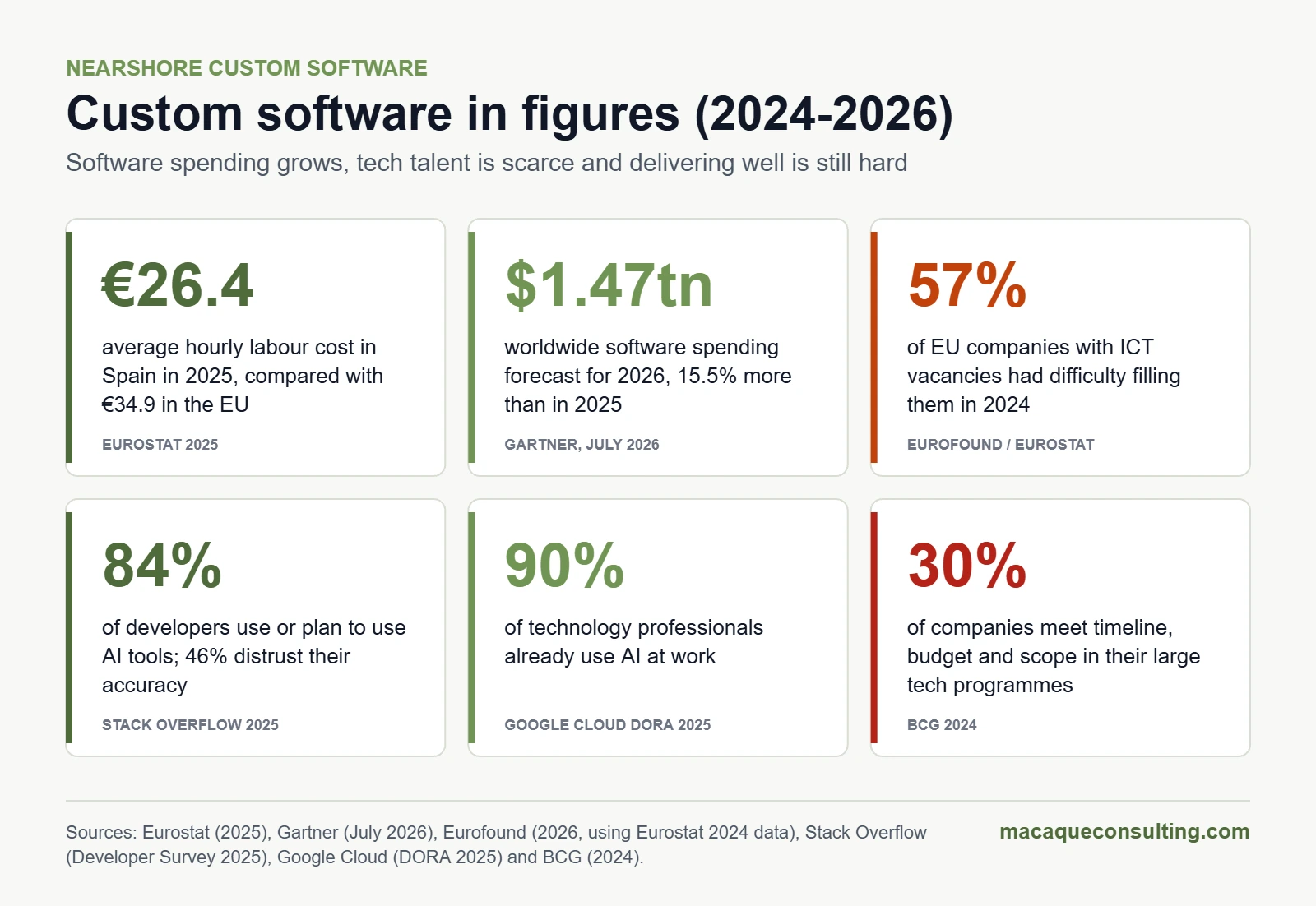
Custom software in figures (2024-2026)
Spending: Gartner expects worldwide software spending to reach $1,468 billion in 2026, 15.5% more than in 2025.
Delivery: only 30% of companies meet timeline, budget and scope expectations in their large technology programmes, according to BCG (2024).
Talent: 57% of EU companies with ICT vacancies had difficulty filling them in 2024 (Eurofound, with Eurostat data).
AI in development: 84% of developers use or plan to use AI tools, but 46% distrust the accuracy of their output (Stack Overflow, 2025), and 90% of technology professionals already use AI at work (Google Cloud DORA, 2025).
Sources: Eurostat, Gartner, Eurofound, Stack Overflow, Google Cloud and BCG.
How much does nearshore custom software development cost?
The price depends mainly on the scope and on who builds it. These are the factors that move it most:
Functional scope: the number of screens, processes, business rules and user roles.
Integrations: every system to connect (ERP, CRM, payment gateway, legacy systems) adds effort and risk.
Platforms: web, iOS and Android multiply the work if they are built separately.
Non-functional requirements: performance, availability, security, accessibility and regulation.
Artificial intelligence: models, data, evaluation of results and API consumption.
Data: migrating and cleaning data from previous systems usually costs more than expected.
Team and pricing model: the seniority of the roles and whether you pay a fixed price, by the hour or by phase.
Indicative 2026 project costs
We calculated these ranges by multiplying the team, in full-time equivalents, by the number of months, by about 160 hours a month and by an average rate of €45 to €60 an hour (€50 to €65 for AI projects), excluding VAT. A team of “3 people” is usually spread across 4 or 5 roles (product, design, development and QA), some of them part-time. Rates by role are in our nearshore guide. These are examples to help you plan, not quotes: the real price comes out of the discovery phase.
Project type
Team (full-time equivalent)
Duration
Indicative cost (excl. VAT)
Discovery phase
1–2 people
2–4 weeks
€3,600–19,200
Focused integration or automation
1–1.5 people
1–2 months
€7,200–28,800
Web or mobile app MVP
3 people
3–4 months
€64,800–115,200
Business platform or custom ERP
4–6 people
6–9 months
€172,800–518,400
SaaS or AI platform
5–7 people
6–9 months
€240,000–655,200
After launch, corrective and evolutive maintenance is usually contracted as an hour bank or a monthly fee: for example, 40 hours a month at €50 an hour is €2,000 a month. For business clients in other EU countries and in the UK, cross-border services are normally invoiced without Spanish VAT, and the client accounts for VAT in its own country under the reverse-charge mechanism.
Fixed price, time and materials, or phased
Model
How it works
When it fits
Main risk
Fixed price
Scope, timeline and price agreed up front
Small, very clear scope
Every change costs extra, and the partner pads the price
Time and materials
You pay for the time actually spent
Scope that changes or evolves
Without scope control, costs spiral
Phased
Discovery first, then a fixed price per release
Most projects
Needs good change management between phases
Dedicated team
Monthly fee for a stable team
A product that evolves continuously
You need a product owner on your side
For medium and large projects we recommend paying by phase: a discovery with its own deliverables, then releases at a fixed price. If you need a stable team instead, see our IT outsourcing and dedicated teams service.
Costs that don't appear in the quote
Cloud infrastructure: servers, databases, backups and test environments.
Third-party licences and APIs: maps, payments, e-signature or AI models paid by usage.
Maintenance: bug fixes, security and dependency updates.
Security: penetration tests and periodic audits.
Data migration and user training.
Travel: an in-person kick-off and regular visits.
Your team's time: defining, validating and testing takes hours from business people.
Total cost of ownership: custom vs SaaS (illustrative example)
Comparing only the upfront price is misleading. This example compares five years for 150 users. The figures are assumptions, not the price of any specific product:
Item (5 years)
Off-the-shelf SaaS
Custom software
Licences (€60 per user per month)
€540,000
—
Initial development
—
€250,000
Evolution and maintenance (€3,000 a month)
Included in the licence
€180,000
Cloud infrastructure (€1,000 a month)
Included in the licence
€60,000
Total
€540,000
€490,000
With these assumptions the cost is similar. The difference is what you get: with custom software the cost doesn't grow with every new user, you own the code and the software does exactly what your process needs. If off-the-shelf software covers your process well, it is usually the sensible choice.
How long it takes
As a guide: two to four weeks for discovery, one to two months for an integration, three to four months for an MVP and six to nine months for a full platform. What speeds things up most is launching an MVP with only the essentials and having a business owner who decides quickly. What slows things down most is uncontrolled changes in requirements, integrations with legacy systems and poor-quality data.
Three illustrative project examples
These examples are illustrative: we built them from common situations and they do not describe specific clients. Costs are calculated with the same method as the table above.
B2B ordering portal for an industrial distributor
Situation: a distributor with 150 employees receives orders by email and spreadsheet, and the sales team types them into the ERP. Solution: a portal where each customer sees its catalogue and prices, places orders and tracks them, integrated with the ERP in real time. Team and timeline: the equivalent of 3 full-time people for 4 months. Indicative cost: €86,400–115,200, excluding VAT. What to measure: the share of orders placed through the portal, handling time per order and order errors.
Job sheet app for a maintenance company
Situation: 60 technicians fill in paper job sheets and invoicing is delayed by days. Solution: a mobile app that works offline, with photos, customer signature and materials, plus a web dashboard for scheduling and integration with invoicing. Team and timeline: the equivalent of 3 full-time people for 3 months. Indicative cost: €64,800–86,400, excluding VAT. What to measure: days between the job and the invoice, and incomplete job sheets.
AI document classification for an insurance broker
Situation: the claims team spends hours reading and sorting the documents customers send. Solution: an AI module that classifies documents, extracts key data and pre-fills the claim file, with human review before every decision. Team and timeline: the equivalent of 4 full-time people for 4 months. Indicative cost: €128,000–166,400, excluding VAT. What to measure: handling time per claim and the share of documents classified correctly without correction. More about the sector on our insurance page.
How a nearshore custom software project works
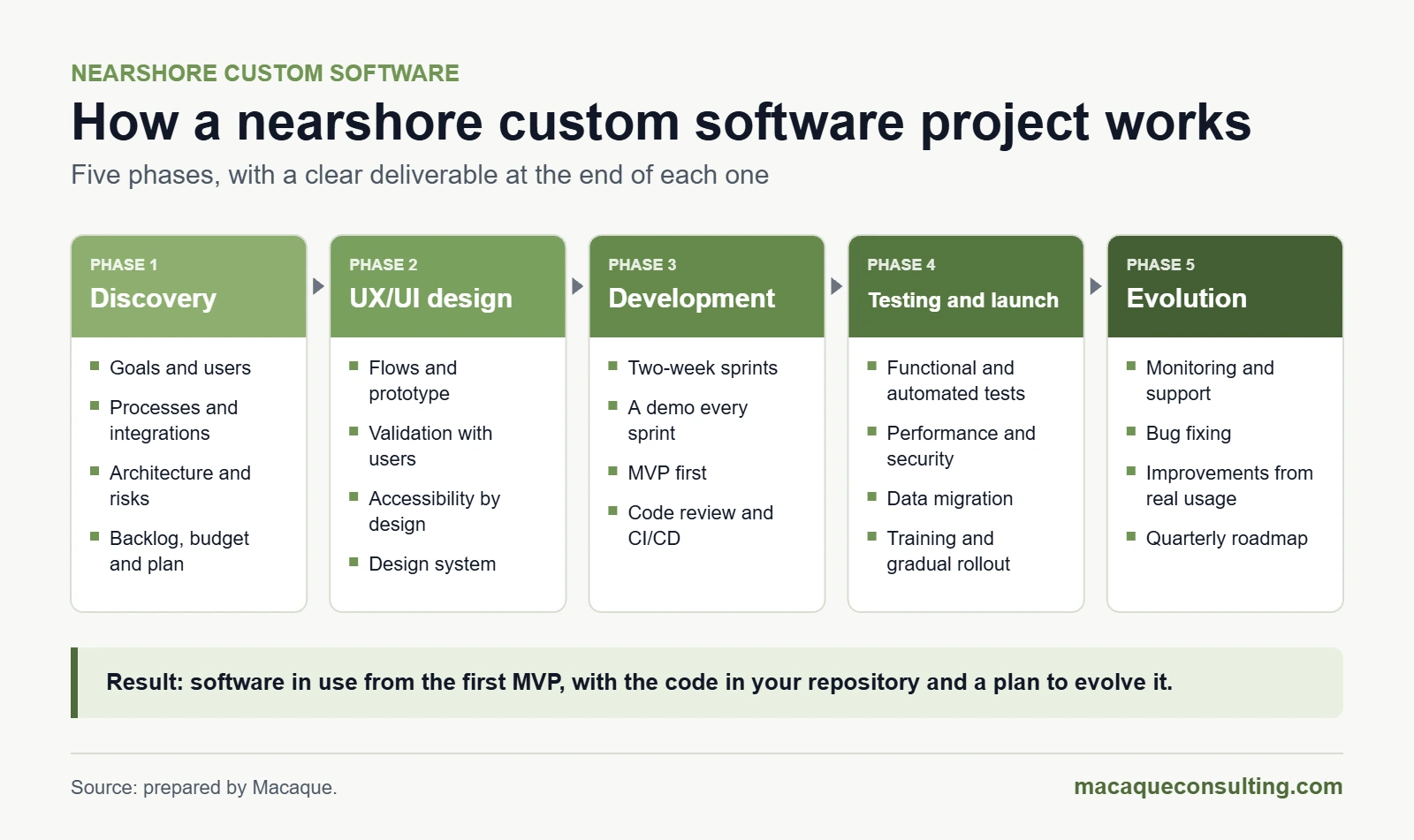
Projects that go well follow a similar sequence, with a clear deliverable at the end of each phase.
Prepared by Macaque.
Discovery: goals, users, processes, requirements, integrations, risks and architecture, ideally with an in-person kick-off. It ends with a prioritised backlog, a budget and a release plan.
UX/UI design and prototype: flows and a clickable prototype validated with real users, with accessibility built in from the start. See our user experience service.
Iterative development: short cycles, usually two weeks long, each ending with a demo. The MVP with only the essentials comes first.
Testing and launch: functional and automated tests, performance and security testing, data migration, training and a gradual rollout. More on how we do it in quality assurance.
Evolution and support: monitoring, bug fixes, improvements based on real usage and a roadmap reviewed every quarter.
Why start with an MVP
An MVP (minimum viable product) is the first version with only what users need to start working with it and give feedback based on real use. It reduces risk, because you find out early what is missing and what is not needed, and it brings the return forward, because the software is in use within months, not years. It is the best defence against the problem BCG describes in large programmes: huge scopes that arrive late and over budget.
Working day to day with a team in Spain
One accountable lead: a delivery manager or tech lead on the partner's side who organises the team and is your single point of contact.
Shared rituals: a short daily stand-up, a demo at the end of every sprint and a monthly review of scope, budget and risks.
Shared tools: your repository, backlog and documentation, in English, accessible to both teams from day one.
In-person moments: a kick-off and workshops at key milestones build trust that video calls alone do not.
Calendar: plan around Spanish public holidays (up to 14 a year, including regional and local ones) and the August holiday period.
Architecture and technology: decisions that last for years
Mainstream technologies: your software should not depend on a language only your partner knows.
Modular architecture: microservices only when there is a reason; a well-modularised monolith is usually cheaper to maintain.
APIs from the start: to integrate with other systems and with AI models.
Cloud and automation: reproducible environments, continuous delivery (CI/CD) and backups. See our DevOps service and our cloud migration guide.
Security and observability by design: access management, encryption, logs and alerts.
Documentation and automated tests: they are what lets you change team without starting again.
Custom software and artificial intelligence
AI inside your software
More and more custom projects include AI: copilots that know company procedures, classification and data extraction from documents, natural-language search over your own information (RAG) or agents that carry out tasks in your systems. What matters most is not the model but the data, the integration with your systems, the evaluation of results and human oversight. We explain it in our AI consultancy guide and in our artificial intelligence service.
AI to build faster
AI has also changed how software is written. 84% of developers use or plan to use AI tools, although 46% distrust the accuracy of what they produce (Stack Overflow, 2025). Google Cloud's 2025 DORA report, based on nearly 5,000 professionals, concludes that AI acts as an amplifier: it speeds up teams with good practices and amplifies the problems of those without them.
In practice, AI shortens timelines for tasks such as boilerplate code, tests and documentation, but it does not replace architecture, code review or testing. So-called vibe coding, writing software by giving instructions to an AI, is very useful for fast prototypes; software that goes into production needs engineers who review what is generated. See our vibe coding service.
Legal: owning your code, data and compliance
Who owns the code when a Spanish partner builds it
Under Spanish law, the economic rights to software created by employees in the course of their duties belong to their employer, unless agreed otherwise (article 97 of the Intellectual Property Act). When your partner's developers are employed in Spain, the rights are your partner's until the contract assigns them to you.
The assignment must be precise. Spanish law limits an assignment to the rights, forms of exploitation, duration and territory agreed; if the contract does not mention the duration, the assignment lasts five years, and if it does not mention the territory, it is limited to the country where it is signed (article 43). So, whatever law governs the contract, it should assign you, exclusively, worldwide and for the full term of protection, the rights to reproduce, modify, distribute and communicate the source code, object code and documentation. It should also:
Give you access to the code and the repository from day one.
List open-source and third-party components, with their licences.
Grant you a perpetual licence to any pre-existing components the partner reuses.
Include technical and deployment documentation.
Data protection
The GDPR requires data protection by design and by default (article 25) and security appropriate to the risk (article 32). If your partner processes personal data on your behalf, you need a data processing agreement (article 28), and high-risk processing requires a data protection impact assessment (article 35). Within the EU no transfer mechanism is needed. For UK companies, data can flow both ways: UK law treats EEA countries as adequate, and the EU renewed its adequacy decisions for the UK until 27 December 2031.
Accessibility: the European Accessibility Act
Since 28 June 2025, the accessibility requirements of the European Accessibility Act apply across the EU to services such as e-commerce, consumer banking, passenger transport and e-books; Spain transposed them in Law 11/2023. If your software serves consumers in these areas, it must be accessible, and the technical reference standard is EN 301 549. Building accessibility in from the design stage costs far less than fixing it later.
Cybersecurity: CRA, NIS2 and DORA
If you will sell your software in the EU as a product with digital elements, the Cyber Resilience Act applies: its vulnerability and incident reporting obligations have applied since 11 September 2026, and the rest applies from 11 December 2027. If your company falls under NIS2 or is a financial entity under DORA, the software and its suppliers are part of your risk management. Read more in our cyber security guide for businesses and on our banking and cybersecurity pages.
Artificial intelligence
If the software includes AI, check what the EU AI Act requires for that use: some transparency obligations already apply, and high-risk systems face stricter requirements. We summarise them in our EU AI Act guide.
What the contract should include
Clause
What it should make clear
Scope and requirements
What will be built, with the requirements document or prioritised backlog as an annex
Deliverables and acceptance
What is delivered in each phase and the criteria for accepting it
Release and payment plan
Milestones, dates and payments linked to accepted releases
Change management
How scope changes are requested, estimated and approved
Intellectual property
Exclusive, worldwide assignment for the full term of protection, including source code and documentation
Code and repository
Access to the repository from the start and handover of everything needed to deploy
Third-party components
Libraries, third-party services and open-source code used, with their licences
Warranty
The period in which the partner fixes defects in delivered work free of charge
Maintenance and SLAs
Response and resolution times after launch
Security and data
Security measures, data processing agreement (article 28 GDPR) and data location
Confidentiality
Protection of your information and know-how
Liability and insurance
Liability caps and the partner's insurance
Exit and handover
How the project is handed over to your team or another partner
Governing law and disputes
Which law applies and which courts or arbitration resolve disputes
How to choose a nearshore custom software development company
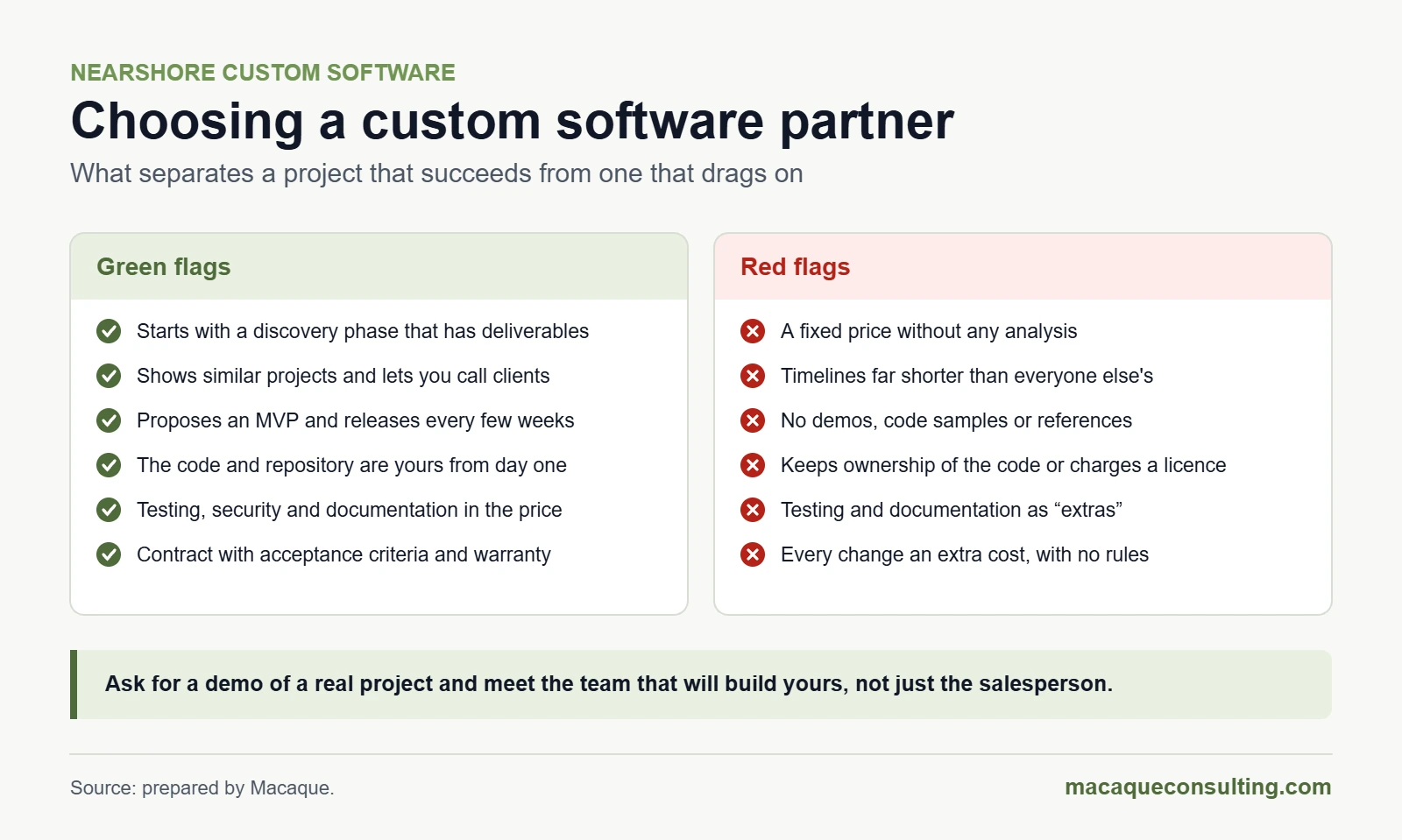
What to look for
Projects similar to yours, with client references you can speak to.
A serious discovery phase before any fixed price.
A complete team: product, design, development and QA, not just developers.
Frequent releases, with demos and repository access from day one.
Measurable quality: automated tests, code review and documentation.
Proven security, such as ISO/IEC 27001 certification.
Transparency on pricing and change management.
Fluent communication in English or your language, especially from the team lead.
The ability to maintain and evolve the software after launch.
Red flags
A fixed price without any analysis.
Timelines far shorter than everyone else's.
No demos, code samples or references.
The partner wants to keep ownership of the code or charge you a licence to use it.
Testing, security and documentation are "extras".
No clear explanation of how changes are managed.
Prepared by Macaque.
8 questions to ask before signing
Which similar projects have you built, and can I speak to those clients?
What does the discovery phase include, and what will I receive at the end?
Who is on the team, and how much time does each person dedicate?
How often will I see working software?
How are changes managed and estimated?
Who will own the code, and when will I get repository access?
Which tests and security measures are included in the price?
What warranty do you give, and how does maintenance work after launch?
Starting to code without discovery. You pay twice: to build and to rebuild.
Wanting everything in the first version. An MVP arrives sooner and learns from users.
Choosing on price alone. Cheap work without tests or documentation is expensive to maintain.
Not involving users. Software is designed with the people who will use it.
Signing without an explicit IP assignment. Without it, the code is not yours.
No access to the repository. If the partner disappears, you are left with nothing.
Forgetting data migration. It is usually harder than it looks.
Leaving security and accessibility to the end. Fixing them later costs more.
Not budgeting for maintenance. Software needs to evolve from day one.
Not measuring. Without KPIs, you will not know whether the project was worth it.
Custom software project checklist
Before you start
Business problem and goals defined.
KPIs to measure success.
A justified decision versus SaaS or low-code.
A product owner on your side, with time.
A budget that includes maintenance.
When choosing a partner
The same brief for every candidate.
References and demos of similar projects.
A discovery phase with deliverables.
A team with design, development and QA.
Proven security.
In the contract
Exclusive, worldwide IP assignment for the full term of protection.
Access to the repository and source code.
Acceptance criteria and payments linked to releases.
Change management and warranty.
Data processing agreement (GDPR) and maintenance SLAs.
During development and after
Demos every two weeks.
Automated tests and code review.
Accessibility and security by design.
Up-to-date documentation.
A roadmap reviewed every quarter.
Custom software glossary
Term
Meaning
Custom software
Software designed and built for the specific needs of one company. Also called bespoke software.
Off-the-shelf software
A product made for many companies, configured and paid for with a licence or subscription.
SaaS
Software as a service: used over the internet and paid for by subscription.
Low-code
Platforms for building apps with little code: fast, but with limits on scale and licensing.
Nearshore
Working with a partner in a nearby country, with little or no time difference.
MVP
Minimum viable product: the first version with only the essentials, built to learn from users.
Discovery
The analysis phase that defines goals, requirements, architecture, budget and plan.
Backlog
A prioritised list of features and pending tasks.
Sprint
A short development cycle, usually two weeks long, that ends with a release.
Acceptance criteria
The conditions a feature must meet to be accepted.
CI/CD
Continuous integration and delivery: automated testing and deployment.
Technical debt
The future cost of shortcuts taken today in code or architecture.
Frequently asked questions about nearshore custom software development
What is nearshore custom software development?
It is having your custom software designed and built by a partner in a nearby country, with little or no time difference, so that its team can work with yours during the same working day. For European companies, Spain is a nearshore option within the EU.
Why build custom software with a team in Spain?
Spain shares Central European Time with most of the continent, applies EU law, and has labour costs below the EU average: €26.4 an hour in 2025, against €34.9 in the EU. A Spanish partner can also provide the whole product team, from design to QA.
How much does custom software cost?
It depends on the scope. With our 2026 rates, a focused integration costs between €7,200 and €28,800, an MVP between €64,800 and €115,200, and a full platform from €172,800, excluding VAT. The real price comes out of a discovery phase.
How long does it take to build custom software?
Two to four weeks of discovery, one to two months for an integration, three to four months for an MVP and six to nine months for a platform. Launching an MVP first means you start using the software much sooner.
Is custom software better than SaaS?
For standard processes, SaaS is usually the better choice. For processes that set you apart, with many integrations or specific requirements, custom software usually pays off. Many companies combine both.
Who owns the code when a Spanish company builds it?
The economic rights belong to the partner until the contract assigns them to you. Under Spanish law, an assignment that does not specify its duration is limited to five years (article 43 of the Intellectual Property Act), so ask for an exclusive, worldwide assignment for the full term of protection, including the source code.
How do we work day to day with a nearshore team?
With one accountable lead on the partner's side, a short daily stand-up, a demo at the end of every two-week sprint, shared tools and documentation in English, and in-person meetings at the kick-off and key milestones.
What is an MVP?
It is the first version of a piece of software with only what users need to start working with it. It lets you validate the product with real users, learn and prioritise what comes next with data.
Can you integrate AI into custom software?
Yes. Language models are integrated through APIs or private deployments and connected to your data, for example with RAG, to classify documents, answer questions or automate tasks. If the software includes AI, also check what the EU AI Act requires.
How do I choose a nearshore custom software development company?
Look for similar projects with references, a serious discovery phase, a complete team, frequent releases, repository access, measurable quality, proven security and fluent communication. Be wary of fixed prices given without prior analysis.
This guide is updated when regulations, data or our rates change. It is for information only and is not legal, tax or technical advice. The project examples are illustrative.
CEO and co-founder of Macaque Group, a technology group based in Calafell (Tarragona, Spain) that specialises in artificial intelligence, software development and IT outsourcing. He advocates AI without the hype: AI that solves real business problems, delivers measurable results and makes it into production. He is a member of OdiseIA, the Spanish observatory on the social and ethical impact of AI, and has been published in Capital Humano (Wolters Kluwer).
Certification corresponding to Macaque Consulting Scope according to certificate.
We process your personal data in accordance with the General Data Protection Regulation (GDPR) and Organic Law 3/2018 (LOPDGDD). See our Privacy Policy.
Obtained
ISO 27701
In progress
ISO 9001
In progress
ENS ALTO
In progress
ISO 42001
Under review
Obtained
ISO 27701
In progress
ISO 9001
In progress
ENS ALTO
In progress
ISO 42001
Under review
Members of
Let's talk about your project
Tell us what you need and we'll reply within 24 working hours.
We drive your business with technology and artificial intelligence
Personalised advice
We analyse your case and propose solutions tailored to your business
Continuous support
From the initial idea through product evolution
Scalable solutions
Technology prepared to grow with you
Availability
Monday - Friday:09:00 - 19:00
Response within 24 hours
This site uses cookies
We use first-party and optional cookies. You can accept them all, reject non-essential cookies or configure them by category. Optional categories are disabled by default and you can change your decision at any time from Cookie settings in the footer.