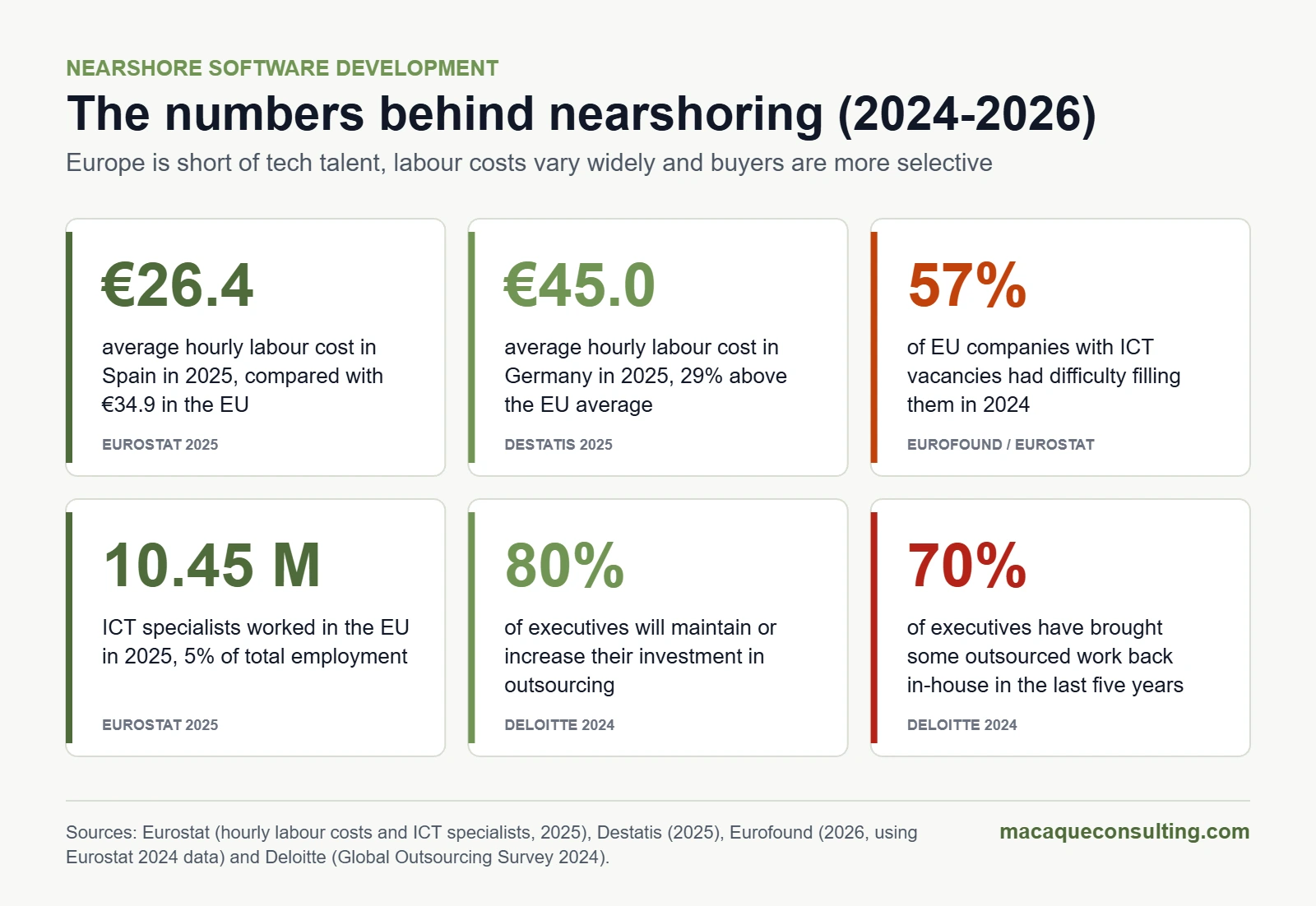
Hiring software engineers in Europe is slow and expensive. In 2024, more than half of the EU companies that recruited or tried to recruit ICT specialists had trouble filling those vacancies. Nearshore software development (working with a partner in a nearby country, in the same or a similar time zone) has become the practical answer for many companies in Germany, the Netherlands, the Nordic countries, France, Belgium, Switzerland and the UK.
Spain is one of the strongest nearshore options in Europe. It shares a time zone with most of the continent, it applies the same EU rules on data protection and cybersecurity, and its average hourly labour cost was €26.4 in 2025, against €34.9 across the EU. This guide explains how nearshore software development works, which engagement model fits each case, what a team in Spain costs in 2026 by role, what to check on GDPR, NIS2 and DORA, and how to choose a partner you can trust.
It is written by Macaque, a Spanish technology consultancy that provides IT outsourcing and staff augmentation, custom software development and hour-bank services. Where we give our own rates or opinions, we say so; everything else is sourced.
Nearshore software development in 60 seconds
What it is: building or running software with a partner in a nearby country, with little or no time difference, instead of hiring at home (onshore) or far away (offshore).
Why Spain: Central European Time, EU law, labour costs well below Northern and Central Europe, and established tech hubs such as Madrid, Barcelona, Valencia and Málaga.
Engagement models: staff augmentation, a dedicated team, a fixed-scope project, managed services or an hour bank. Avoid body shopping.
Cost: our indicative 2026 rates range from €25 to €90 an hour depending on the role and seniority, and from €100 to €160 for architecture and technical leadership, excluding VAT.
Compliance: within the EU no data transfer mechanism is needed, and the EU has renewed its adequacy decisions for the UK until December 2031. Keep day-to-day management with the partner to avoid disguised agency work.
How to choose: check references, technical vetting, real team management, security certifications, the replacement policy and pricing transparency, and start with a pilot.
What is nearshore software development?
Nearshore software development means designing, building or running software with an external partner based in a nearby country, usually no more than one or two hours from your time zone. The partner provides engineers, a complete team or a managed service, and works with your people in real time, during the same working day.
It sits between two other options. Onshore means working with a provider in your own country. Offshore means working with a provider far away, with several hours of time difference. For a company in Germany, the Netherlands, France, the Nordic countries or the UK, Spain is nearshore: a short flight away, in the same or an adjacent time zone and, for EU companies, under the same legal framework.
What you can nearshore
Area
Examples
Software and product development
Web platforms, back-end services, APIs, internal tools and integrations
Mobile
Native iOS and Android apps, cross-platform apps
Data and AI
Data engineering, analytics and BI, machine learning, generative AI and agents
Cloud and DevOps
Infrastructure as code, CI/CD, monitoring, cloud cost optimisation
Quality assurance
Manual testing, test automation, accessibility testing
UX/UI design, business analysis, product owners, project managers and scrum masters
Most companies start with one team or one service and extend the model once it works. Decide first what stays in-house: product vision, key architecture decisions and the knowledge that makes your business different should remain under your control, even when a partner builds most of the software.
Nearshore vs offshore vs onshore
The right option depends on how much real-time collaboration the work needs, how sensitive the data is and how much you want to save. This is how the three compare for a European company:
Factor
Onshore
Nearshore (Spain)
Offshore
Time difference
None
None, or one hour for the UK, Ireland and Portugal
Several hours
Real-time collaboration
The full working day
The full working day
A few overlapping hours, if any
Legal framework
Your own
EU law: GDPR, NIS2, DORA, AI Act
A different one; personal data transfers usually need extra safeguards
Labour costs
Highest
Lower than in Northern and Central Europe
Lowest
Travel
Local
Short flights
Long-haul flights
Typical risk
Availability and cost of talent
Choosing the wrong partner
Communication, quality control and compliance
Offshore can work for well-defined tasks that need little interaction. For product development, where engineers, product owners and business teams talk every day, the shared working day of nearshore usually pays for itself: fewer misunderstandings, faster feedback and less waiting.
Why Spain for nearshore software development
The same working day. Mainland Spain and the Balearic Islands use Central European Time, like Germany, France, Italy, the Netherlands, Belgium, Austria, Switzerland, Poland and the Scandinavian countries. The UK, Ireland and Portugal are one hour behind.
The same EU rules. The GDPR, DORA and the AI Act apply directly in Spain, as in every member state, and NIS2 sets common cybersecurity requirements across the EU. For an EU company, working with a Spanish partner does not involve an international data transfer.
Lower labour costs. The average hourly labour cost in Spain was €26.4 in 2025, compared with €34.9 in the EU, €38.2 in the euro area and €45.0 in Germany.
Established tech hubs. Madrid, Barcelona, Valencia and Málaga concentrate technology companies, start-ups and engineering centres of international groups.
English: test it in interviews. Spain ranks 36th of 123 countries in the EF English Proficiency Index 2025, in the moderate band, with stronger reading than speaking skills. Interview every engineer in English and make sure the team lead is fluent.
Easy travel. Spain is a short flight from most European capitals, so in-person kick-offs, workshops and regular visits are realistic.
Cultural proximity. Working practices and business culture are close to the rest of Europe. Plan around Spanish public holidays (up to 14 a year, including regional and local ones) and the August holiday period.
Labour costs in Spain compared with other European countries
The table shows average hourly labour costs in 2025 for the whole economy, excluding agriculture and public administration. They include wages and employer costs such as social security contributions. They are not IT rates: technology salaries are above the average in every country, but the relative gap is a useful reference.
Country or area
Average hourly labour cost (2025)
Luxembourg
€56.8
Denmark
€51.7
Netherlands
€47.9
Germany
€45.0
Euro area
€38.2
European Union
€34.9
Spain
€26.4
Sources: Eurostat and, for Germany, Destatis. A lower labour cost does not automatically mean a cheaper project: what matters is the total cost of getting the result, including management time and quality. We look at that in the cost section below.
Sources: Eurostat, Destatis, Eurofound and Deloitte.
Engagement models for a nearshore development team
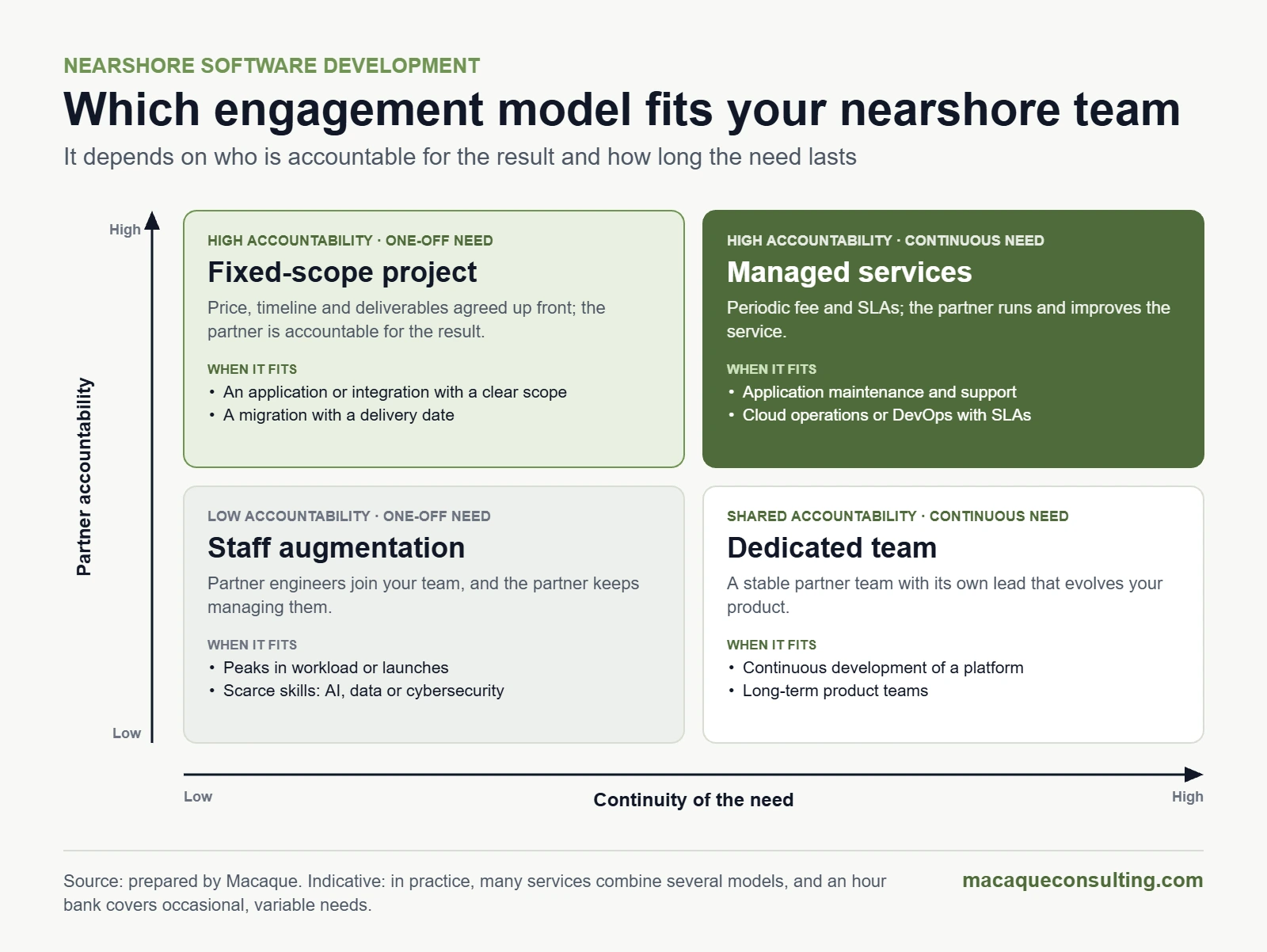
There is no single nearshore model. What changes from one to another is who organises the work and who is accountable for the result. Choosing well matters for the outcome and, as we explain in the legal section, for compliance.
Staff augmentation (team augmentation)
The partner adds engineers to your team to cover a skills gap or a peak in workload. You set the goals and priorities; the partner remains the employer, selects and manages its people and is responsible for their performance, continuity and replacement. It is the fastest way to add specific skills without a long hiring process.
Dedicated development team
A stable team, usually with a team lead or delivery manager from the partner, works continuously on your product. It builds and keeps deep knowledge of your domain, and it is the most common nearshore model for long-term product development.
Fixed-scope project
Price, timeline and deliverables are agreed up front, and the partner is accountable for delivering them. It needs a clear scope, and changes go through change requests. It suits an application, an integration or a migration with a defined result: see our custom software development service.
Managed services
The partner runs and improves a service, such as application maintenance, support, cloud operations or DevOps, for a periodic fee and with service level agreements (SLAs). You pay for outcomes and availability, not for hours.
Hour bank
A block of prepaid hours used on demand for maintenance, small improvements or specialist advice. It suits variable or occasional needs that do not justify a dedicated team.
Body shopping: why to avoid it
Body shopping means supplying people by the hour without management, method or accountability. It looks cheap, but it concentrates every risk: turnover, dependency on individuals, no quality control and, in Spain and many other countries, legal exposure for disguised agency work.
Model
Who organises the work
Who is accountable for the result
Typical pricing
Best for
Staff augmentation
You set the goals; the partner manages its people
You
Hourly or monthly rate per role
Skills gaps and peaks in workload
Dedicated team
The partner's team lead, with your product owner
Shared
Monthly fee per team
Long-term product development
Fixed-scope project
The partner
The partner
Fixed price
Clearly defined deliverables
Managed services
The partner
The partner, measured by SLAs
Periodic fee
Ongoing operations and support
Hour bank
The partner, on request
The partner, task by task
Prepaid hours
Variable or occasional needs
Prepared by Macaque.
How much does nearshore software development in Spain cost?
The price depends mainly on the role, its seniority and the engagement model. These are the factors that move it most:
Role and scarcity: AI, data, DevOps, cybersecurity and architecture cost more than roles with a larger talent pool.
Seniority: between a junior and a senior engineer in the same specialism, the rate almost doubles.
Commitment and duration: a stable, full-time commitment usually lowers the hourly rate compared with occasional needs.
Engagement model: a fixed-scope project or a service with SLAs includes management and delivery risk, and that has a price.
Special requirements: on-call rotas, extended hours, on-site presence, languages or specific security requirements.
Indicative 2026 rates by role
These are the hourly ranges Macaque works with in 2026, in euros and excluding VAT. Each level (junior, mid-level and senior) has three steps depending on experience and specialisation, and the final price depends on the project.
AI and data
Role
Junior
Mid-level
Senior
AI Engineer
€35–45
€50–60
€65–75
FDE (Forward Deployed Engineer)
—
€60–70
€75–90
Data Scientist / ML Engineer
€35–45
€50–60
€65–75
MLOps / LLMOps Engineer
€40–50
€55–65
€70–80
Data Engineer
€30–40
€45–55
€60–70
Data / BI Analyst
€30–40
€45–55
€60–70
Development and platforms
Role
Junior
Mid-level
Senior
Back-end Developer
€35–45
€50–60
€65–75
Full Stack Developer
€30–40
€45–55
€60–70
Front-end Developer
€25–35
€40–50
€55–65
Native Mobile Developer (iOS / Android)
€30–40
€45–55
€60–70
Cross-platform Mobile Developer (Flutter, React Native)
€25–35
€40–50
€55–65
SAP Consultant
€40–50
€55–65
€70–85
Salesforce Developer
€35–45
€50–60
€65–75
Low-code / Power Platform Developer
€30–40
€45–55
€60–70
RPA Developer
€30–40
€45–55
€60–70
Cloud, infrastructure and security
Role
Junior
Mid-level
Senior
DevOps / Cloud Engineer
€40–50
€55–65
€70–80
SRE (Site Reliability Engineer)
€45–55
€60–70
€75–85
Cybersecurity Engineer
€40–50
€55–65
€70–80
SOC Analyst
€30–40
€45–55
€60–70
Systems Administrator
€25–35
€40–50
€55–65
Database Administrator (DBA)
€35–45
€50–60
€65–75
Quality assurance (QA)
Role
Junior
Mid-level
Senior
Manual QA Tester
€25–35
€40–50
€55–65
QA Automation Engineer
€30–40
€45–55
€60–70
Accessibility QA Specialist
€25–35
€40–50
€55–65
Product, design and delivery
Role
Junior
Mid-level
Senior
UX/UI Designer
€30–40
€45–55
€60–70
Business Analyst
€30–40
€45–55
€60–70
Product Owner
€25–35
€40–50
€55–65
Project Manager
€25–35
€40–50
€55–65
Scrum Master
€30–40
€45–55
€60–70
Agile Coach
—
€50–60
€65–80
Architecture and technical leadership
Role
Hourly range
Software, Cloud, Data or AI Architect
€100–140
Tech Lead
€100–150
Fractional CTO
€120–160
As a reference, a role at €50 an hour working full time (about 160 hours a month) comes to about €8,000 a month. Dedicated teams and managed services are usually billed as a monthly fee rather than by the hour. For business clients in other EU countries and in the UK, cross-border services are normally invoiced without Spanish VAT, and the client accounts for VAT in its own country under the reverse-charge mechanism.
Partner or direct hire in Spain?
Some companies consider hiring in Spain directly, through their own Spanish entity or an employer of record. To compare that option with a partner's rate, start from the total employment cost, not the salary. In 2026, Spanish employers pay social security contributions of 30.65% of the contribution base (23.60% for common contingencies, 5.50% for unemployment on permanent contracts, 0.20% for the wage guarantee fund, 0.60% for vocational training and 0.75% for the intergenerational equity mechanism), plus an occupational accident premium that depends on the activity. The maximum contribution base is €5,101.20 a month.
Example: an engineer earning €45,000 gross a year
Amount
Gross annual salary
€45,000.00
Employer social security contributions (30.65%)
€13,792.50
Employment cost, before occupational accident premiums
€58,792.50
Per hour, assuming 1,600 productive hours a year
€36.75
That figure still leaves out costs that never appear on a payslip: recruitment time and fees, the ramp-up period, equipment and licences, training, management time, holidays and sick leave, turnover, idle time between projects and, if you have no Spanish entity, the cost of setting one up or paying an employer of record. Direct hiring also makes you responsible for complying with Spanish employment law. Hiring freelancers as a shortcut carries its own risk: if they work like employees, they can be reclassified as bogus self-employed workers.
The rule of thumb: for stable, core, long-term roles, an in-house team usually costs less in the long run. For peaks in workload, scarce skills, projects with an end date or uncertain needs, a partner is usually more efficient.
Hidden costs of nearshoring
Managing the partner: someone on your side needs time to prioritise, review and coordinate.
Onboarding and transition: during the first weeks, the team learns your business and your systems.
Turnover: every change of person costs context, so agree replacement times and overlap periods.
Lock-in: without documentation and knowledge transfer, changing partner is expensive.
Travel: budget for an in-person kick-off and regular visits.
Price reviews: check how rates are updated every year.
How to compare proposals
Ask every partner for the same thing: the same scope, the same roles and the same commitment. Then compare what each price includes (management, replacements, training, equipment and licences), minimum terms and notice periods, the annual price review and the cost of exit. The cheapest hourly rate is not always the cheapest option at the end of the contract.
Legal and compliance: what to check
Working with a partner in another EU country is legally simpler than offshoring, but some points need attention from day one.
Data protection: GDPR and UK GDPR
If the partner processes personal data on your behalf, it acts as a processor, and you need a data processing agreement that meets article 28 of the GDPR: instructions, confidentiality, security measures, sub-processors, help with data subject rights, deletion or return of data, and audits. Within the EU and the EEA no transfer mechanism is needed, but check where your partner's own tools and sub-processors are located.
For UK companies, data can flow in both directions. UK law treats EEA countries as adequate, and on 19 December 2025 the European Commission renewed its adequacy decisions for the UK, which now run until 27 December 2031. The two regimes are no longer identical (the UK Data (Use and Access) Act 2025 changed some provisions), so your contracts should reference both where relevant.
Keep day-to-day management with the partner
In staff augmentation, the line between buying a service and borrowing workers is a legal one, not just a contractual detail. In Spain, article 43 of the Workers' Statute prohibits the illegal assignment of workers: supplying staff to another company without being a licensed temporary work agency or providing a real service. Other countries have similar rules; in Germany, for example, the Temporary Agency Work Act (AÜG) regulates the leasing of employees. Whatever the contract says, courts and inspectors look at who actually directs the work.
In practice, define the contract as a service with goals, deliverables or capabilities; make sure the partner has a team lead who organises the work; channel requests through that person; and leave holidays, absences, training and performance with the partner. Your managers should never set working hours, approve holidays or apply sanctions. Take local legal advice when in doubt.
NIS2, DORA and supply-chain security
If your company is an essential or important entity under NIS2, your suppliers are part of your cybersecurity risk management: the directive requires measures for supply-chain security, including the security aspects of your relationships with direct suppliers and service providers. If you are a financial entity under DORA, contracts for ICT services must include specific provisions, such as a description of the services, where data is processed, access to and return of data and, for critical or important functions, audit rights and exit strategies. Those providers must also appear in your register of information.
Under Spanish law, the economic rights to software created by employees in the course of their duties belong to the employer, unless agreed otherwise (article 97 of the Intellectual Property Act). In other words, your partner owns the code its people write until the contract assigns it to you. Make sure the agreement transfers ownership of code, documentation and other deliverables, covers open-source licences and third-party components, and sets confidentiality obligations. If the service includes AI systems, also review your obligations under the EU AI Act.
If the team travels to your offices
Remote work from Spain is the norm in nearshore development. If engineers travel to work at your premises for a period, EU posting rules apply: the partner must respect your country's core employment conditions under the Posted Workers Directive, usually has to notify the posting to your local authorities, and can keep its people in the Spanish social security system with an A1 certificate. Many countries treat short business trips for meetings differently from postings, so check local rules. The UK is outside these EU rules: check its visitor and immigration rules before any on-site work.
What the contract should include
Clause
What it should make clear
Purpose and scope
What service is provided, what is included and what is not
Model and governance
Who organises the work, the contacts on each side and the follow-up meetings
SLAs and KPIs
Availability, response and resolution times, quality, and how they are measured
Service credits
What happens if SLAs are missed, for example discounts on the invoice
Roles and replacements
Required experience, time to replace a person and overlap period
Price and review
Rates, invoicing, expenses and how prices are updated each year
Intellectual property
Who owns the code, models and documentation
Confidentiality and security
Non-disclosure, access management, certifications and incident notification
Data protection
Data processing agreement (article 28 GDPR), sub-processors and data location
Subcontracting
Whether the partner can subcontract, and with what control
Audit
The right to check compliance and request evidence
Term and exit
Duration, notice, exit plan, handover of documentation and knowledge transfer
Liability and insurance
Liability caps, professional indemnity and cyber insurance
Governing law and disputes
Which law applies and which courts or arbitration will resolve disputes
How to set up a nearshore development team in five phases
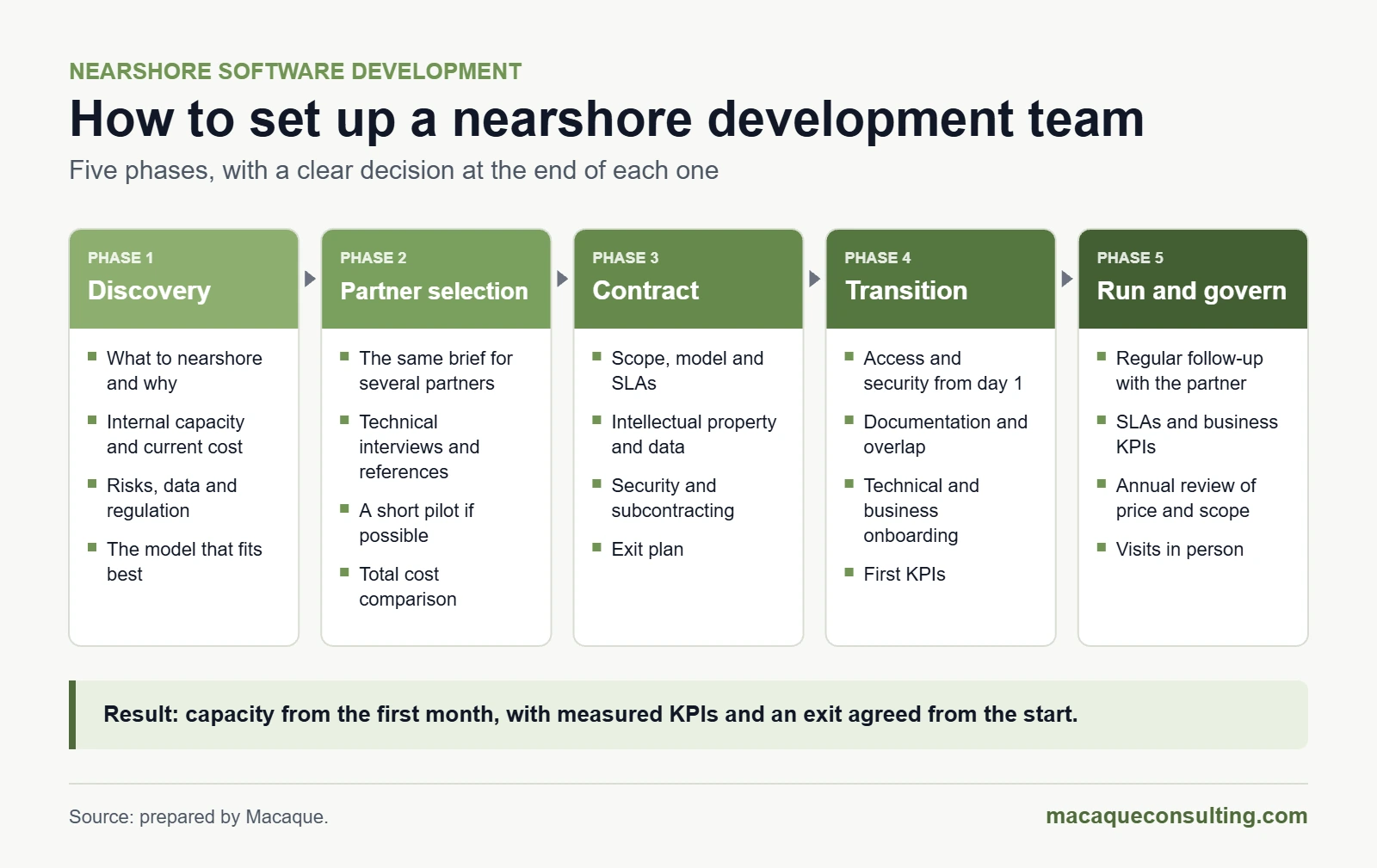
The nearshore set-ups that work follow a similar sequence, with a clear decision at the end of each phase.
Prepared by Macaque.
Discovery: what to nearshore and why, your internal capacity, what it costs today, the risks and the model that fits best.
Partner selection: the same brief for several partners, technical interviews, references and, if possible, a short pilot.
Contract: scope, model, SLAs, intellectual property, data protection, security and an exit plan.
Transition: access and security from day one, documentation, overlap with whoever did the work before, technical and business onboarding, and the first KPIs.
Run and govern: regular meetings, SLA and business KPI tracking, an annual review of price and scope, continuous improvement and regular visits in person.
How to choose a nearshore software development company
What to look for
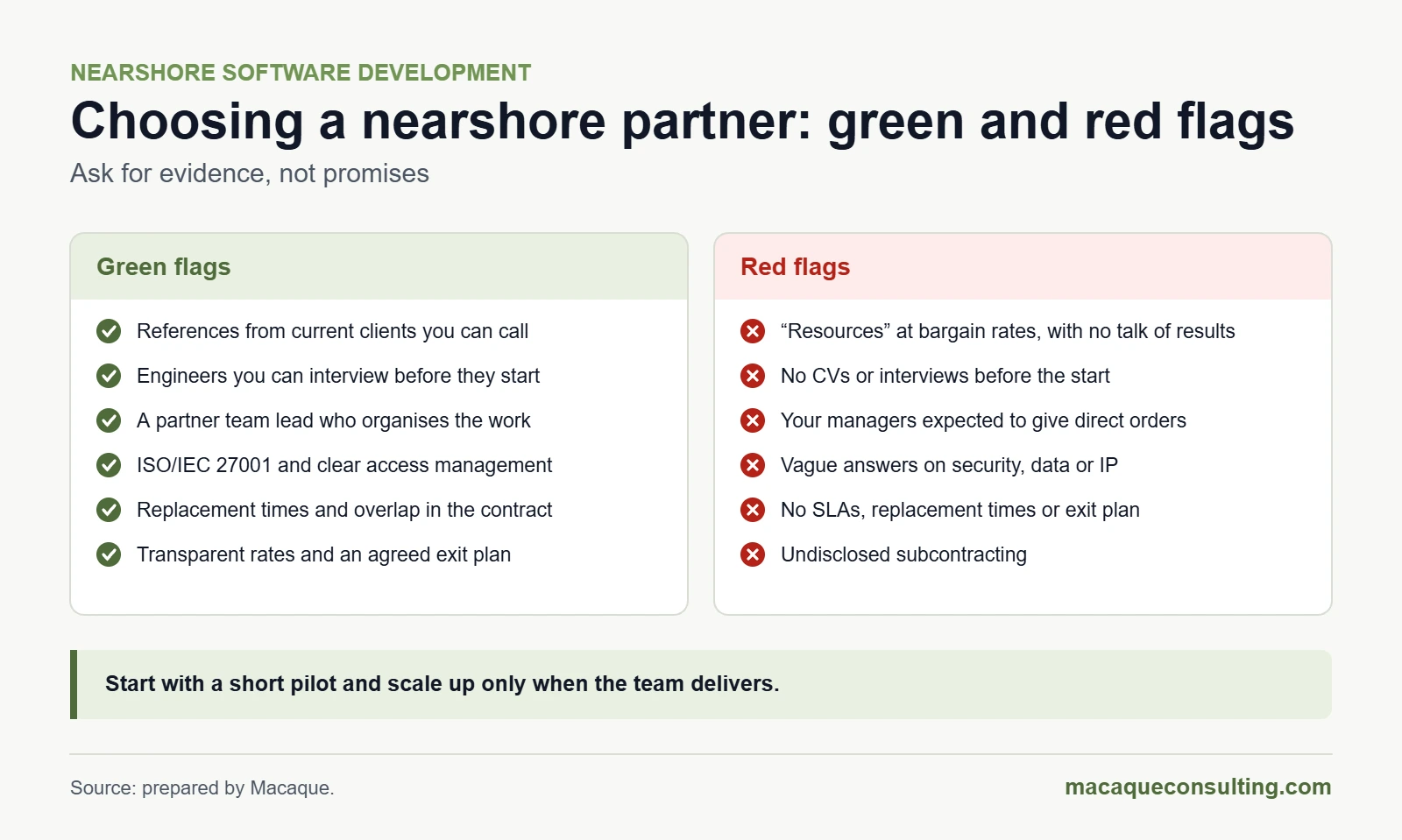
Proven experience with your technology and in your industry. Ask for references from current clients.
A serious technical selection process: practical tests and interviews with senior engineers.
Real team management: a team lead or delivery manager from the partner who organises the work, follows up and is accountable.
Proven security: ISO/IEC 27001 and, where relevant, the requirements of DORA or your sector.
A replacement policy with clear timelines and an overlap period.
Transparent pricing: what each rate includes and how it is reviewed.
Talent retention: ask about staff turnover in their teams.
Knowledge transfer and documentation as part of the service.
Communication: team leads who can run meetings and write documentation in English, or in your language.
Red flags
Offering "resources" at bargain rates without talking about management or results.
Not introducing the people before the start, or not letting you interview them.
Expecting your managers to give direct orders, control working hours or approve holidays.
No clear answers on security, data protection or intellectual property.
Contracts without SLAs, replacement times or an exit plan.
Subcontracting to third parties without telling you.
Prepared by Macaque.
8 questions to ask before signing
Which similar projects do you run, and can I speak to those clients?
How do you select and technically assess your engineers?
Who organises the team day to day, and how do you follow up?
How quickly do you replace someone, and with what overlap?
What exactly does the rate include, and how is it reviewed each year?
Which security certifications do you hold, and how do you manage access?
Who will own the code and the documentation?
How would the exit work if we decided to bring the work in-house or change partner?
10 common mistakes when nearshoring software development
Choosing on hourly rate alone. What counts is the total cost and the result.
Nearshoring without clear goals. Without objectives and KPIs, there is nothing to measure.
Treating staff augmentation as borrowing people. It is the fastest route to disguised agency work.
Not allocating internal time to manage the partner. Nearshoring does not manage itself.
Handing over critical knowledge without documentation or knowledge transfer.
Leaving security and access until there is an incident.
Signing without SLAs or service credits.
Not agreeing the exit from the start.
Accepting constant turnover without overlap periods.
Never reviewing the model: what makes sense to nearshore today may be worth bringing in-house tomorrow.
Trends: AI is changing nearshore outsourcing
Partners that work with AI: 83% of executives expect their providers to build AI into the service, although the benefits are still modest: fewer than half see productivity improvements (Deloitte).
More outcome-based pricing: models linked to results are gaining ground (Deloitte), and AI is putting pressure on prices based only on hours worked (ISG).
New roles: at Macaque we see growing demand for AI engineers, forward deployed engineers (FDEs) and MLOps specialists, roles that are very hard to hire in-house.
Hybrid models: companies combine in-house teams and partners, and bring back in-house what becomes strategic. 70% of executives have insourced some previously outsourced work in the last five years (Deloitte).
Current cost calculated with the full employment cost, not the salary.
Engagement model chosen: staff augmentation, dedicated team, fixed-scope project, managed services or hour bank.
An internal owner with time to manage the partner.
When choosing a partner
The same brief for every candidate.
Technical interviews with the proposed engineers, in English or in your language.
References from current clients.
Security certifications checked.
Comparison of the total cost, not just the rate.
In the contract
Purpose defined as a service, not as a supply of people.
SLAs, service credits and replacements.
Assignment of intellectual property and confidentiality.
Data processing agreement (GDPR and, if relevant, UK GDPR).
Exit plan and knowledge transfer.
During the service
A partner team lead who organises the team.
Regular follow-up meetings and visits in person.
KPIs reviewed every quarter.
Up-to-date documentation.
Annual review of price, scope and model.
Nearshore software development glossary
Term
Meaning
Nearshore
Working with a partner in a nearby country, with little or no time difference.
Offshore
Working with a partner far away, usually with several hours of time difference.
Onshore
Working with a provider in your own country.
Staff augmentation
Adding a partner's professionals to your team while the partner keeps managing them. Also called team augmentation.
Dedicated team
A stable team from the partner that works continuously on your product.
Managed services
A service that the partner runs and improves for a periodic fee, with SLAs.
Hour bank
A block of prepaid hours used on demand.
Body shopping
Supplying people by the hour without management or accountability from the provider.
SLA
Service level agreement: measurable commitments on quality, availability and response times.
DPA
Data processing agreement: the contract required by article 28 of the GDPR when a provider processes personal data on your behalf.
Adequacy decision
A European Commission decision recognising that a non-EU country protects personal data to an essentially equivalent level.
FDE (Forward Deployed Engineer)
An engineer who works closely with the client to take a solution, often an AI one, into production.
Frequently asked questions about nearshore software development
What is nearshore software development?
It is working with a software partner in a nearby country, with little or no time difference, so that its engineers can collaborate with your team during the same working day. The partner can provide individual engineers, a complete team or a managed service.
Why choose Spain for nearshore software development?
Spain shares Central European Time with most of the continent, applies EU law on data protection and cybersecurity, and has labour costs below the EU average: €26.4 an hour in 2025, against €34.9 in the EU. It also has established tech hubs such as Madrid, Barcelona, Valencia and Málaga, and it is a short flight from most European capitals.
How much does a nearshore developer in Spain cost?
It depends on the role, seniority and engagement model. Our indicative 2026 rates range from €25 to €90 an hour depending on the role, and from €100 to €160 for architecture and technical leadership, excluding VAT. As a reference, €50 an hour full time comes to about €8,000 a month.
What is the difference between nearshore and offshore?
Distance and time zone. A nearshore partner shares your working day and, within the EU, your legal framework. An offshore partner is usually cheaper in labour costs, but with fewer overlapping hours, more coordination effort and, often, extra safeguards for personal data transfers.
What is the difference between staff augmentation and a dedicated team?
With staff augmentation, individual engineers join your team: you set the goals and the partner keeps managing its people. A dedicated team is a complete, stable team with its own team lead that works continuously on your product, with shared accountability for the result.
Can a Spanish partner work with UK companies under data protection law?
Yes. UK law treats EEA countries as adequate, and the European Commission renewed its adequacy decisions for the UK in December 2025, until 27 December 2031. You still need a data processing agreement, and your contracts should reference both the GDPR and the UK GDPR where relevant.
What level of English can I expect from a team in Spain?
It varies from person to person. Spain ranks 36th of 123 countries in the EF English Proficiency Index 2025, in the moderate band. Interview every engineer in English and ask for team leads who are fluent, especially if they will run meetings with your business teams.
How long does it take to set up a nearshore team?
It depends on the roles and their seniority: roles with a large talent pool are filled sooner than scarce ones, such as a senior AI engineer. Ask the partner to commit in writing to a deadline for presenting candidates and another for the start date, and plan a transition period with overlap.
Who owns the code written by a nearshore team?
Under Spanish law, the economic rights to software created by employees belong to their employer, the partner, unless agreed otherwise. Your contract must assign ownership of the code, documentation and other deliverables to your company.
What is a forward deployed engineer (FDE)?
An engineer who works closely with the client to adapt and implement a technology solution, especially an AI one, until it works in production. The role combines strong technical skills with direct contact with the business.
CEO and co-founder of Macaque Group, a technology group based in Calafell (Tarragona, Spain) that specialises in artificial intelligence, software development and IT outsourcing. He advocates AI without the hype: AI that solves real business problems, delivers measurable results and makes it into production. He is a member of OdiseIA, the Spanish observatory on the social and ethical impact of AI, and has been published in Capital Humano (Wolters Kluwer).
Certification corresponding to Macaque Consulting Scope according to certificate.
We process your personal data in accordance with the General Data Protection Regulation (GDPR) and Organic Law 3/2018 (LOPDGDD). See our Privacy Policy.
Obtained
ISO 27701
In progress
ISO 9001
In progress
ENS ALTO
In progress
ISO 42001
Under review
Obtained
ISO 27701
In progress
ISO 9001
In progress
ENS ALTO
In progress
ISO 42001
Under review
Members of
Let's talk about your project
Tell us what you need and we'll reply within 24 working hours.
We drive your business with technology and artificial intelligence
Personalised advice
We analyse your case and propose solutions tailored to your business
Continuous support
From the initial idea through product evolution
Scalable solutions
Technology prepared to grow with you
Availability
Monday - Friday:09:00 - 19:00
Response within 24 hours
This site uses cookies
We use first-party and optional cookies. You can accept them all, reject non-essential cookies or configure them by category. Optional categories are disabled by default and you can change your decision at any time from Cookie settings in the footer.