Artificial intelligence is now firmly part of business life. In Spain, 33.6% of companies with 10 or more employees used some form of AI in the first quarter of 2026, up from 21.1% a year earlier, according to the National Statistics Institute (INE); across the EU, 20% of enterprises used AI in 2025. The challenge is no longer getting started but getting results: most organisations still see no clear impact from AI on their bottom line.
This guide explains what an AI consultancy does, which services it should include, how a project works from start to finish, what it costs and how to measure the return, what the EU AI Act and the GDPR require, and how to choose the right partner without falling for empty promises. With 2025 and 2026 data, a checklist and the questions to ask before you sign.
AI consultancy in 60 seconds
What it is: a service that helps a business decide where AI adds value, take it into production with its own data and systems, and govern it securely and within the law.
Why now: adoption is growing fast, but only 37% of organisations attribute any impact on operating profit (EBIT) to AI, according to McKinsey. The bottleneck is moving from pilot to production.
What it includes: strategy and use cases, data preparation, proof of concept, development and integration, governance and compliance, training and ongoing operations.
How it works: diagnosis, use-case prioritisation, a proof of concept with success criteria, implementation and scaling.
What the law says: the EU AI Act already requires AI literacy from staff who use AI and bans certain practices; high-risk obligations arrive in December 2027 and August 2028.
How to choose: demonstrable use cases in production, business focus, technology independence, security and compliance, and knowledge transfer to your team.
What is AI consultancy?
An AI consultancy helps an organisation use artificial intelligence to solve specific business problems: identifying where it creates value, checking that it is feasible with the organisation's data, building and integrating the solution into its processes and systems, and running it securely, with cost control and regulatory compliance. A good AI consultant combines three capabilities rarely found in one person: business knowledge, technical skills (data, models and integration) and regulatory judgement.
It is not the same as buying a tool. A software vendor sells you its product; a consultancy should recommend the best option for your case, even if that is a tool you already have, or none at all.
What a good AI consultancy does (and does not do)
Does
Does not
Starts with the business problem and the metrics that need to move
Starts with the latest technology trend
Reviews your data before promising results
Promises savings percentages without seeing your data
Defines success criteria before each proof of concept
Runs pilot after pilot with no plan to reach production
Integrates AI into your systems and processes
Delivers an isolated demo
Builds in security, privacy and compliance from the design stage
Leaves the AI Act and the GDPR until the end
Trains your team and documents its work
Leaves you dependent on it for everything
Types of AI provider: who you can hire
Type of provider
A good fit if…
Watch out for…
Large generalist consultancies
You are tackling a very broad transformation programme, or one spanning several countries
Costs and structures designed for large programmes
Specialist AI consultancies
You want focus, a senior team and fast progress to production
Check they have data and integration capability, not just prototyping skills
Software vendors and platforms
Your use case fits a standard product
They will recommend their own product; watch out for lock-in
Integrators and developers
You need to build and integrate a bespoke solution
Make sure they understand the business and the risks, not just the code
Freelancers
You need a specific, well-defined task
Continuity, security and accountability if something goes wrong
Technology centres and universities
You are looking for applied research or a publicly funded R&D project
Timelines and focus geared more towards research
AI in business, in figures (2025-2026)
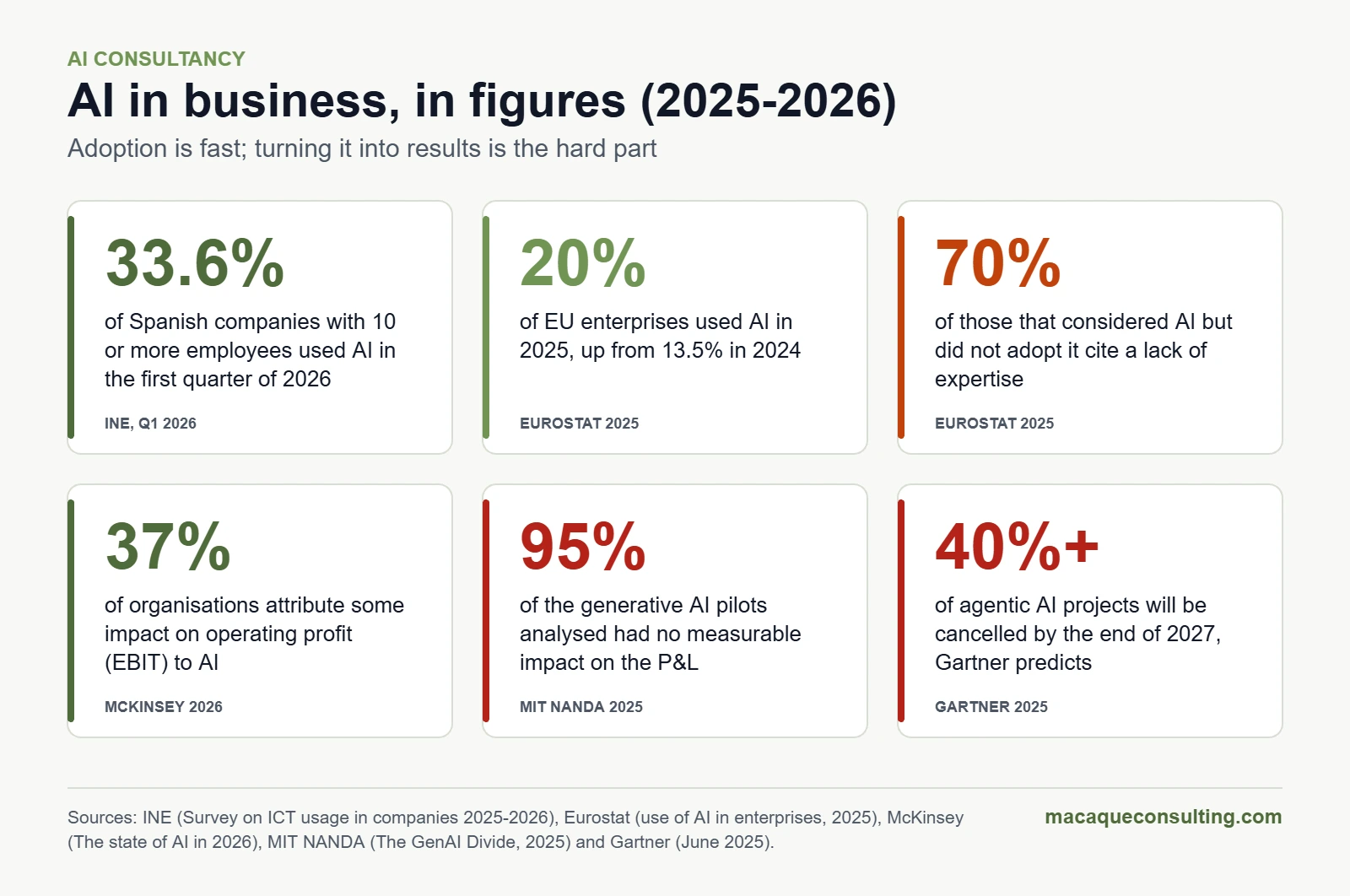
The latest data paint the same picture everywhere: AI is spreading fast, but the value is concentrated in a few organisations.
Spain: 33.6% of companies with 10 or more employees used AI in the first quarter of 2026, up from 21.1% in the same period of 2025 (INE).
Europe: 20% of EU enterprises used AI in 2025, up from 13.5% in 2024. Denmark (42%), Finland (37.8%) and Sweden (35%) lead the way, and the most common use is analysing written language (Eurostat).
The size gap: 55% of large EU enterprises use AI, compared with 19% of SMEs (Eurostat, 2025 data).
Lack of expertise: among European enterprises that considered using AI but did not, 70% cite a lack of relevant expertise and 54% legal uncertainty (Eurostat, 2025).
From use to impact: almost nine in ten organisations use AI regularly, but only 37% attribute any EBIT impact to it, and just 6% say it contributes at least 5% of their EBIT (McKinsey, The state of AI in 2026).
Pilots that never take off: 95% of the generative AI pilots analysed by MIT had no measurable impact on the P&L (MIT NANDA, 2025).
Agents, with caution: Gartner predicts that over 40% of agentic AI projects will be cancelled by the end of 2027 due to rising costs, unclear value or inadequate risk controls.
Sources: INE, Eurostat, McKinsey, MIT NANDA and Gartner.
AI consulting services: what they include
A full-service consultancy covers the whole journey, from strategy to operations. Not every project needs every service, but it pays to know which ones exist so that nothing critical is missed.
1. AI readiness assessment and strategy
Assesses the company's maturity, goals and processes and turns them into a roadmap with priorities, investment and owners. It includes an inventory of the AI already in use, including the tools employees use on their own. It is the starting point of our artificial intelligence service.
2. Use-case identification and prioritisation
Workshops with business teams to gather ideas and score them on impact and feasibility. The result is a shortlist of use cases, each with its own business case.
3. Data: quality, access and governance
AI is only as good as the data it receives. This workstream reviews what data exists, where it lives, how good it is and who can use it, and prepares the architecture needed. It ties in with data strategy and cloud data engineering.
4. Proof of concept and minimum viable product
A tightly scoped test, with real data and a quantified success criterion, to check whether the use case works before investing seriously. If it passes, it becomes a minimum viable product with real users.
5. Development and integration
Building the solution and connecting it to the company's systems (ERP, CRM, document management, customer service channels): generative AI assistants that answer from your documents, agents, predictive models, computer vision or process automation with RPA. When a standard product is not enough, custom software comes into play.
6. Governance, risk and compliance
An inventory of AI systems, risk classification under the AI Act, GDPR impact assessments, usage policies, human oversight and, for organisations that want to go further, a management system based on ISO/IEC 42001. An AI audit shows where you stand.
7. Training and change management
Training tailored to each role, which is also mandatory: the AI Act requires AI literacy from those who use these systems. Without adoption, no solution delivers results.
8. Operations and continuous improvement
Once in production, AI needs monitoring: answer quality, changes in the data, usage costs, security against attacks such as prompt injection, and model updates. This is known as MLOps or LLMOps.
How an AI consultancy project works: 5 phases
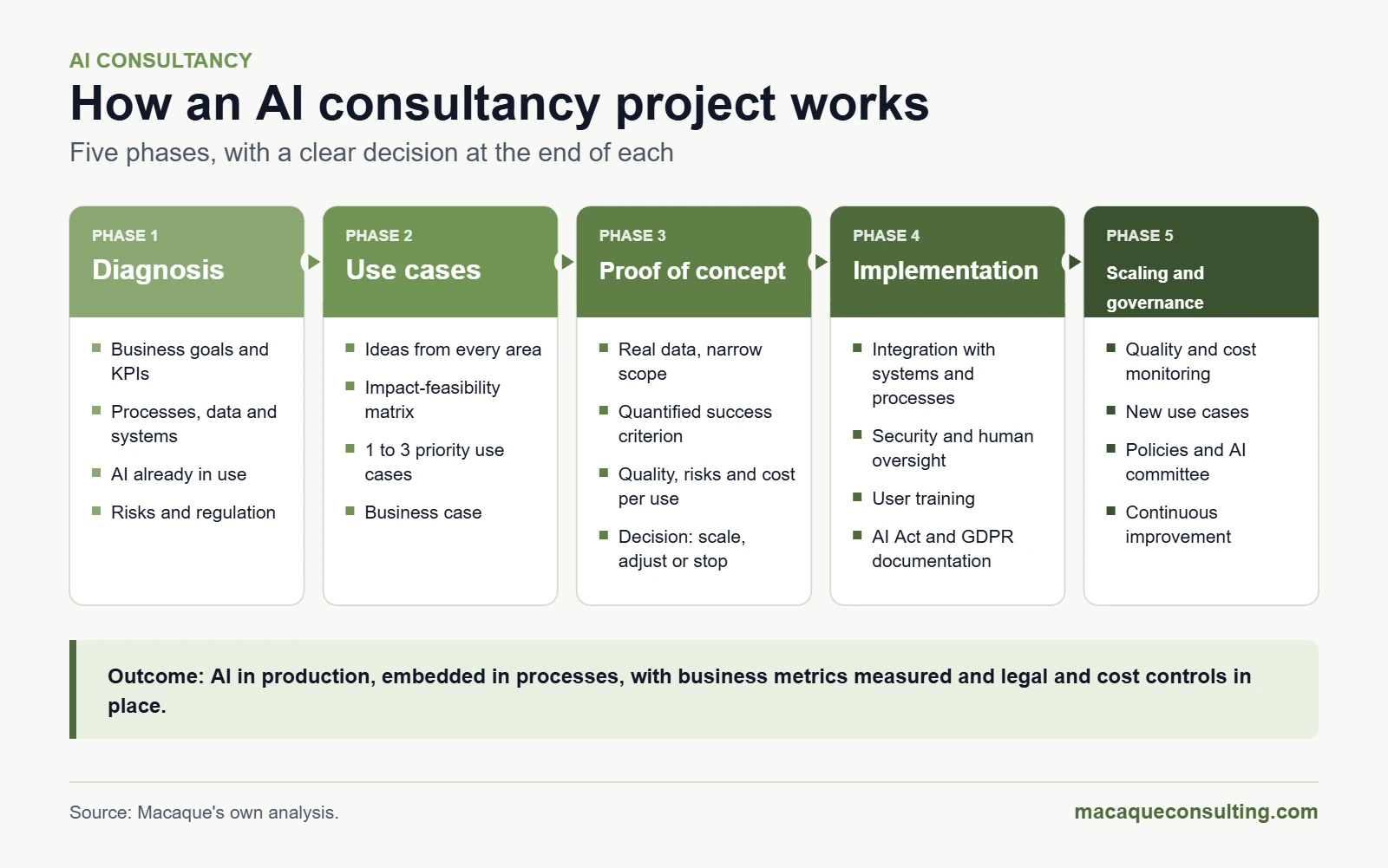
Every consultancy has its own method, but the projects that reach production follow a similar sequence. The key is to decide, before each phase, what result justifies moving on to the next.
Macaque's own analysis.
Phase 1. Diagnosis and objectives
Interviews with leadership and business areas, a review of processes, data, systems and risks, and an inventory of the AI already in use. The business metrics the project must move are agreed. The output is an opportunity map and a roadmap.
Phase 2. Use cases and prioritisation
Ideas are gathered from every area and scored on impact and feasibility, and one to three use cases are selected, each with its own business case.
Phase 3. Proof of concept
With real data and a narrow scope, the quality of the output, the risks and the cost per use are measured against a success criterion set in advance. It ends with an explicit decision: scale, adjust or stop.
Phase 4. Implementation and integration
The solution is integrated into systems and processes, with access controls, logging, human oversight where needed, user training and the documentation required by the AI Act and the GDPR.
Phase 5. Scaling, governance and continuous improvement
Quality and cost monitoring, new use cases on the same foundations and a stable governance framework: policies, owners and, in large organisations, an AI committee.
According to McKinsey, the organisations that get the most value from AI redesign their workflows around it rather than bolting it onto existing ones. That is why phase 4 is not just technical: it also changes how people work.
How to choose AI use cases: impact versus feasibility
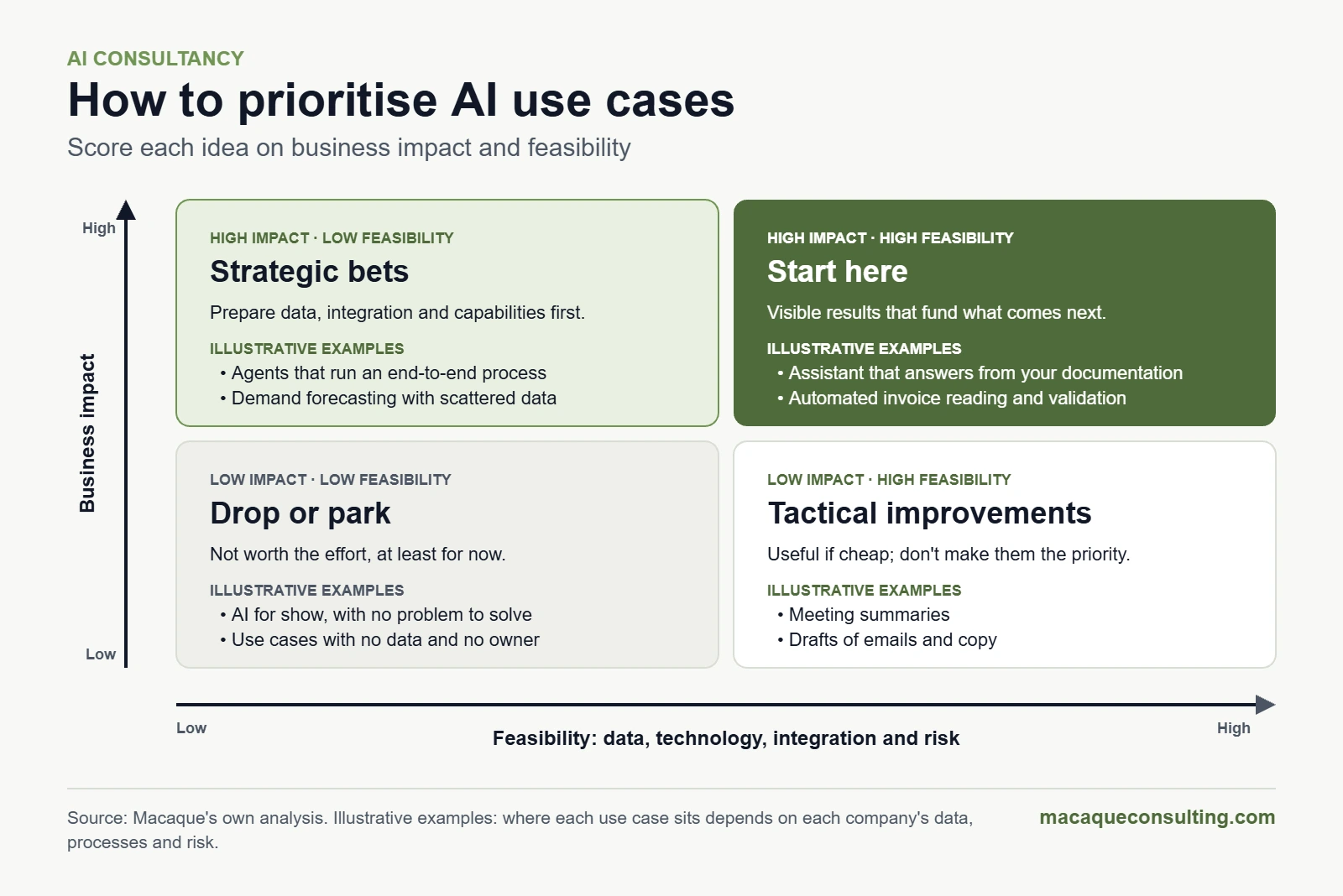
Choosing the right first use case is the decision that most shapes the outcome. A simple method is to score each idea on two axes:
Impact: time or cost savings, revenue, fewer errors or risks, and a better customer or employee experience.
Feasibility: available, good-quality data, technical complexity, integration with existing systems, regulatory risk and the change effort required from people.
Start with high-impact, high-feasibility use cases: they deliver visible results and help fund what comes next. MIT found that many companies focus their pilots on sales and marketing, while the clearest returns often come from the back office: operations, finance, procurement or document management.
Macaque's own analysis.
Examples of use cases by business area
Area
Examples
Customer service
Assistants that answer frequent queries from your documentation, ticket classification and routing, conversation summaries
Sales and marketing
Demand forecasting, lead prioritisation, content personalisation, call analysis
Operations
Predictive maintenance, quality control with computer vision, route and inventory optimisation
Finance
Invoice reading and reconciliation, anomaly and fraud detection, cash-flow forecasting
Human resources
Searching internal policies, training support, survey analysis. Note: using AI to select or assess people is high-risk under the AI Act
Legal and compliance
Contract review and comparison, regulatory research, due diligence support
IT and development
Coding assistants, technical documentation, internal support
Creating, summarising, translating or searching text, images or code
Assistant that answers from internal documentation (RAG)
AI agents
Chaining several steps and acting in systems with some autonomy
Handling a support ticket end to end with human oversight
Computer vision
Analysing images and video
Defect detection on a production line
AI-powered automation
Running repetitive, rule-based tasks, with AI to read documents
Entering orders from emails and PDFs
AI agents for business: when they make sense and when they don't
AI agents are systems that plan and carry out multi-step tasks using the company's tools and systems. Their use is growing, especially in large organisations: according to McKinsey, 40% of those with revenues above $1 billion are already scaling agents, compared with a steady 22% among smaller ones. Gartner, however, predicts that over 40% of agentic AI projects will be cancelled by the end of 2027 and warns of agent washing: existing products, such as chatbots or automation tools, rebranded as agents.
Yes: multi-step processes with clear rules, accessible data and a limited cost of error, with a person overseeing the decisions that matter.
Not yet: critical decisions without oversight, undocumented processes, or cases that a simple automated workflow already handles.
If you want to start with agents, choose a narrow, measurable one.
How much does AI consultancy cost?
There is no standard rate: the price depends on the scope, the state of your data, the complexity of the integration and the security and compliance requirements. What you do need to understand are the engagement models and the costs that do not appear in the first proposal.
Engagement models
Model
How it works
A good fit when…
Fixed-price project
A fixed price for a defined scope, such as a diagnosis or a proof of concept
The goal and deliverables are clear
Time and materials
You pay for the hours or days worked
The scope is going to evolve
Managed service
A recurring fee for evolution, support and operations
Model usage: calls to AI models are paid per use (for example, per token) and grow with adoption. According to McKinsey, around one in five respondents say these costs already limit their use of AI.
Infrastructure and data: storage, processing, vector databases and integration. If your data is still in your own data centre, our cloud migration guide will help you plan that step.
Licences for tools and platforms.
Operations: monitoring, quality evaluation, security and updates.
People: training and the time business teams spend on the project.
Funding in Spain: Kit Consulting, which funded digital transformation and AI advisory services for SMEs, is not accepting new applications: the last deadline for signing agreements was 31 May 2026 and Red.es has not announced a new call. Check its official website before counting on it.
How to measure the return on AI
Baseline: measure how the process performs today (time, cost, errors, volume) before changing anything.
Business metrics, not usage metrics: hours saved, cost per transaction, error rate, response time, conversion, satisfaction or risk avoided. A tool being used does not mean it adds value.
Total cost: development, licences, usage, operations and internal time.
Decision criterion: what result justifies scaling, adjusting or stopping, set before the proof of concept.
Follow-up: models and processes change; review the metrics at least quarterly.
The data confirm the gap between individual productivity and business impact: 80% of McKinsey's respondents say AI has improved their personal productivity, but only 37% see an impact on their organisation's EBIT.
Regulation and governance: what your consultancy must master
EU AI Act: obligations and dates
Since 2 February 2025: prohibited practices and the AI literacy obligation (Article 4): anyone who uses or deploys AI must ensure their staff have sufficient knowledge.
Since 2 August 2025: rules for providers of general-purpose AI models.
Since 2 August 2026: transparency obligations, such as telling people they are interacting with an AI.
High-risk: the Digital Omnibus (Regulation (EU) 2026/1744), in force since 27 July 2026, postponed these obligations to 2 December 2027 for uses such as employment, education or credit, and to 2 August 2028 for AI embedded in regulated products.
In Spain, the AI Act is overseen by the Spanish Agency for the Supervision of Artificial Intelligence (AESIA). You will find all the details in our complete guide to the EU AI Act.
If you are in the UK: the AI Act is EU law, but it also applies to UK organisations that place AI systems on the EU market or whose AI output is used in the EU. The UK has no AI-specific legislation yet: its approach, set out in the government's 2023 white paper, relies on existing regulators applying cross-sector principles.
GDPR and UK GDPR: personal data travels in prompts too
A lawful basis and a defined purpose for every use of personal data, including feeding an assistant or fine-tuning a model.
A data protection impact assessment (DPIA) where the processing is high-risk.
The right not to be subject to decisions based solely on automated processing with significant effects (Article 22 of the GDPR).
Data processing agreements with AI providers and control over international transfers.
Clear rules on what data can be entered into AI tools.
In the UK, the Data (Use and Access) Act 2025 introduced a more permissive framework for solely automated decisions, in force since 5 February 2026. Safeguards still apply: people must be informed and be able to contest the decision and obtain human intervention, and stricter rules remain where special category data is involved.
ISO/IEC 42001: the AI management system
ISO/IEC 42001, published in December 2023, is the first international standard for AI management systems. It is voluntary and certifiable, applies to any organisation that develops, provides or uses AI, and offers a structure for managing risks, responsibilities and controls. It does not replace the AI Act, but it helps demonstrate that AI is managed methodically.
Usage policy and shadow AI
Many employees already use AI tools on their own: the MIT report describes a ‘shadow AI economy’ of personal tools used outside company control. Banning them rarely works; what does work is a clear usage policy, secure corporate tools and training. This is also the basis of the AI literacy the AI Act requires, and a security front we cover in our cyber security guide for businesses.
In-house, outsourced or a hybrid model?
According to MIT, generative AI projects bought from specialist vendors or built in partnership with them succeed about 67% of the time, while internal builds succeed only a third as often. That does not mean outsourcing everything, but combining each option well:
Option
Advantages
Disadvantages
A good fit when…
In-house team
Full control and business knowledge
Scarce, expensive talent; learning curve
You already have a data and AI team with production experience
External consultancy
Accumulated experience, method and speed
Risk of dependency if it does not transfer knowledge
You are starting out or need to accelerate specific use cases
Hybrid model
Speed now and in-house capability later
Requires coordination and an internal owner
You want AI to become a lasting capability of the business
How to choose an AI consultancy: criteria and red flags
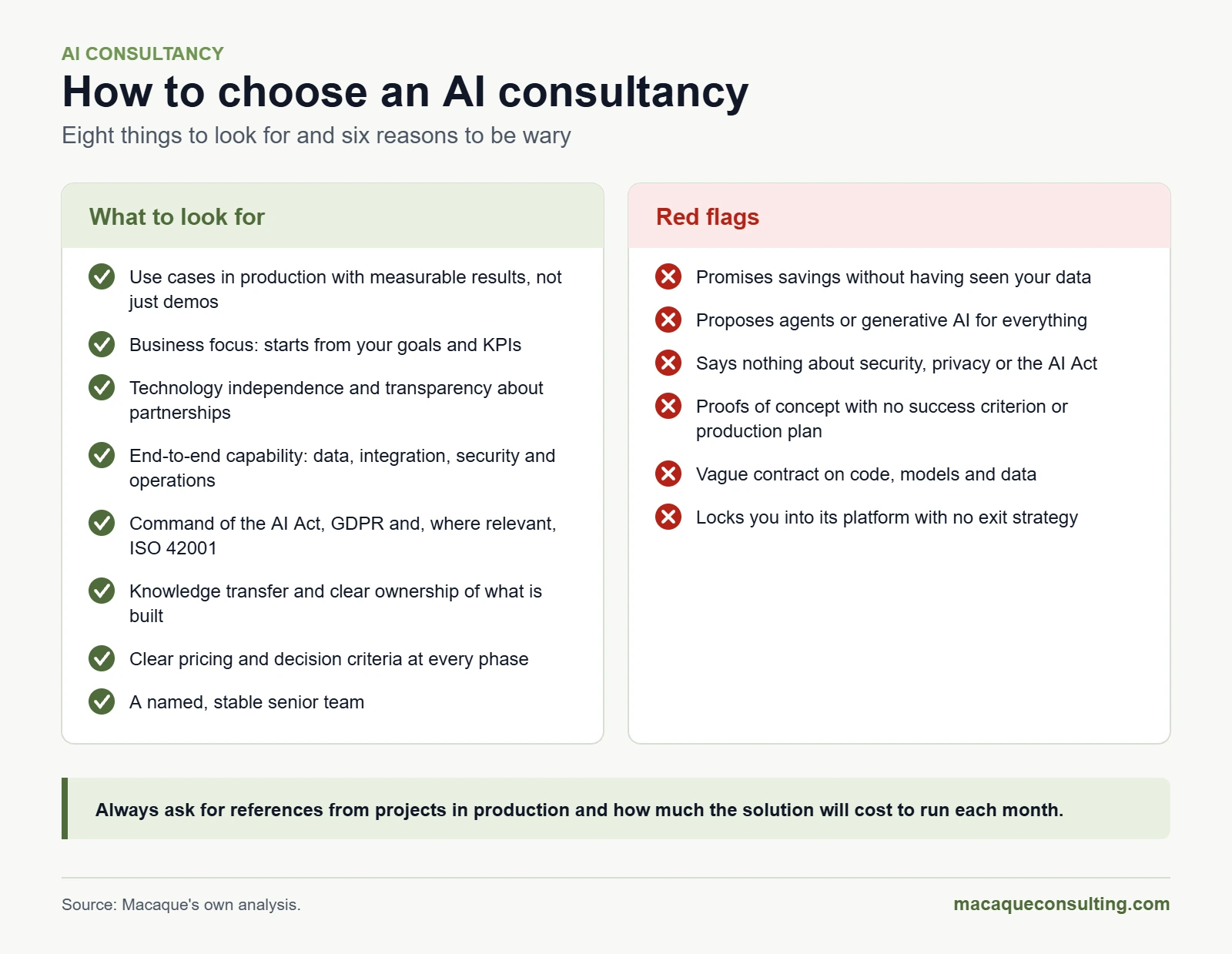
Macaque's own analysis.
What to look for
Use cases in production with measurable results, not just demos. Ask for references.
Business focus: it should start from your goals and metrics.
Technology independence and transparency about its vendor partnerships.
End-to-end capability: data, integration, security and operations, not just prototypes.
Regulatory expertise: the AI Act, the GDPR and, where relevant, sector regulation and ISO/IEC 42001.
Knowledge transfer: training, documentation and clear ownership of what is built.
Clear pricing and decision criteria at every phase.
A named senior team that stays stable throughout the project.
Red flags
It promises savings or percentages without having seen your data.
It proposes agents or generative AI for everything.
It says nothing about security, privacy or the AI Act.
It proposes proofs of concept with no success criterion or plan for production.
The contract is vague about who owns the code, the models and the data.
It locks you into its platform with no exit strategy.
8 questions to ask before you sign
Which similar projects do you have in production, and what results have they delivered?
Which metrics will we measure, and what is the baseline?
What happens if the proof of concept does not meet its target?
Where will our data be processed, and who will have access to it?
How do you cover the AI Act and data protection law in this project?
Who will own what is built: code, fine-tuned models and documentation?
How much will it cost to run each month once it is in production?
How will we become self-sufficient?
The 10 most common mistakes when implementing AI
Starting with the technology, not the problem. The question is not ‘what can we do with AI?’ but which metric we want to move.
Running pilot after pilot with no production plan. Without a success criterion or a budget to scale, the pilot remains a demo.
Underestimating the data. It is usually most of the work.
Ignoring integration. AI that is not built into everyday tools does not get used.
Adding AI to the old process instead of redesigning it.
Forgetting the people: training, change management and mandatory AI literacy.
Leaving security and privacy until the end.
Not monitoring model usage costs as adoption grows.
Tolerating shadow AI without a usage policy.
Measuring usage instead of impact.
Where to start, depending on the size of your business
Small business (10-49 employees): a usage policy, basic training and one or two high-impact use cases with tools you already have or can buy as a service.
Medium-sized business (50-249): a diagnosis and roadmap, data in order, a well-measured proof of concept and a first governance framework.
Large enterprise (250 or more): an AI programme with an owner and a committee, a common platform, an inventory and risk classification under the AI Act, governance aligned with ISO/IEC 42001, and use cases scaled area by area.
Checklist for hiring an AI consultancy
Before you start
Business goal and metrics defined.
Inventory of the AI already in use, including unauthorised tools.
Available data identified and accessible.
An internal project owner.
An approved AI usage policy.
During the proof of concept
Use case prioritised by impact and feasibility.
Quantified success criterion and measured baseline.
Real data, with permissions and anonymisation where needed.
Assessment of quality, risks and cost per use.
An explicit decision: scale, adjust or stop.
Before going into production
System classified under the AI Act.
DPIA if it processes high-risk personal data.
Security reviewed: access, logging and prompt-injection testing.
Human oversight defined.
Users trained.
In production
Quality and costs monitored.
Business metrics reviewed every quarter.
Documentation kept up to date.
Ownership of code, models and data clearly set out in the contract.
A plan to build internal self-sufficiency.
Quick AI glossary for business
Term
What it means
Generative AI
AI that creates new content (text, images, code) from instructions.
LLM
Large language model, such as those behind ChatGPT, Gemini or Copilot.
RAG
A technique that makes the model answer using information from your own documents.
AI agent
A system that plans and carries out multi-step tasks using tools and systems.
Prompt
An instruction given to an AI model.
Hallucination
A false or made-up answer that the model presents as true.
Fine-tuning
Additional training of a model on your own data for a specific task.
Proof of concept
A tightly scoped test to check whether a use case works with real data.
MLOps and LLMOps
Practices for deploying, monitoring and maintaining models in production.
AI literacy
The knowledge the AI Act requires of staff who use or deploy AI.
ISO/IEC 42001
Voluntary, certifiable international standard for AI management systems.
Shadow AI
Employees' use of AI tools outside company control.
Frequently asked questions about AI consultancy
What does an AI consultancy do?
It helps you identify where AI adds value, check that it is feasible with your data, develop it and integrate it into your processes, and govern it securely and in line with regulation. A good consultancy measures the outcome in business metrics.
How much does AI consultancy cost?
It depends on the scope, the state of the data and the integration required. The usual route is to start with a fixed-price diagnosis or proof of concept and then move on to a project or a managed service. Always factor in the running costs: model usage, infrastructure and maintenance.
How long does an AI project take to deliver results?
It depends on the use case and the data. A narrow use case with accessible data can be validated in a short proof of concept; taking it into production and integrating it into processes takes longer. What matters is agreeing from the outset what result is expected and when it will be assessed.
What is the difference between an AI consultancy and an AI software vendor?
The vendor sells its product. A consultancy should recommend the best solution for your case, whether it comes from a vendor, is custom-built or is a tool you already have, and help you integrate and govern it.
Do I need perfect data to get started?
No, but you do need to know what data you have, where it is and how good it is. Preparing it for the chosen use case is part of the consultancy's work.
Is AI training for staff mandatory?
Under the EU AI Act, yes. Since 2 February 2025, anyone who uses or deploys AI systems must ensure their staff have a sufficient level of AI literacy, appropriate to their role and to how they use AI.
Does the AI Act affect me if I only use ChatGPT or Copilot?
Yes, though with limited obligations: AI literacy, not using it for prohibited practices and complying with the transparency rules if you publish AI-generated or manipulated content. If you use it in high-risk processes, such as recruitment, you will have greater obligations from December 2027.
Is it better to develop AI in-house or hire a consultancy?
It depends on your internal capability. According to MIT, projects with specialist vendors succeed more often than internal builds. A hybrid model often works well: accelerate with outside help while building in-house capability.
What is ISO 42001 and do I need it?
It is the international standard for AI management systems. It is voluntary; it makes sense if you develop or use AI intensively, operate in a regulated sector or your customers ask for assurances about how you manage AI.
What are AI agents and does my business need them?
They are systems that carry out multi-step tasks with some autonomy. They can add a lot of value in well-defined processes, but they are not needed for everything: Gartner predicts that over 40% of agentic AI projects will be cancelled by the end of 2027. Start with a narrow, measurable use case.
CEO and co-founder of Macaque Group, a technology group based in Calafell (Tarragona, Spain) that specialises in artificial intelligence, software development and IT outsourcing. He advocates AI without the hype: AI that solves real business problems, delivers measurable results and makes it into production. He is a member of OdiseIA, the Spanish observatory on the social and ethical impact of AI, and has been published in Capital Humano (Wolters Kluwer).
Certification corresponding to Macaque Consulting Scope according to certificate.
We process your personal data in accordance with the General Data Protection Regulation (GDPR) and Organic Law 3/2018 (LOPDGDD). See our Privacy Policy.
Obtained
ISO 27701
In progress
ISO 9001
In progress
ENS ALTO
In progress
ISO 42001
Under review
Obtained
ISO 27701
In progress
ISO 9001
In progress
ENS ALTO
In progress
ISO 42001
Under review
Members of
Let's talk about your project
Tell us what you need and we'll reply within 24 working hours.
We drive your business with technology and artificial intelligence
Personalised advice
We analyse your case and propose solutions tailored to your business
Continuous support
From the initial idea through product evolution
Scalable solutions
Technology prepared to grow with you
Availability
Monday - Friday:09:00 - 19:00
Response within 24 hours
This site uses cookies
We use first-party and optional cookies. You can accept them all, reject non-essential cookies or configure them by category. Optional categories are disabled by default and you can change your decision at any time from Cookie settings in the footer.